
Brigid Hughes
The Democratic Republic of Congo (DRC) and Sierra Leone have both faced severe human rights abuses due to the exploitation of critical minerals in their mining sectors. The DRC’s cobalt mining sector is accompanied by forced labor, child labor and exploitation, and overall unsafe working conditions. These abusive conditions are fueled primarily by the high demand for cobalt, which is used in relatively new technologies such as electric vehicle batteries and smartphones. In Sierra Leone, the mining of “conflict diamonds” witnessed similar conditions for exploited workers, but also fueled a long-lasting and devastating civil war, which began in 1991 and ended in 2002. The moral implications of the conditions within these industries and the consequences of these abuses in civil society have gained the attention of various non-governmental organizations (NGOs), who have worked tirelessly to pressure corporations and governments to address their own role in exploitation and to implement policies to change the conditions in which violations occur.
My research has two goals: to investigate the strategies employed by NGOs in order to mobilize actors, and to understand the differences in outcomes of these strategies. To this point, I chose to analyse two cases, Sierra Leone and the Democratic Republic of Congo, which revealed to me that Sierra Leone had a more successful reform following NGO strategies, whereas the DRC did not witness successful reform. Comparable on the ground mining conditions and consequent abuses, as well as similar strategies employed by NGOs in order to mobilize actors inspired me to research these two cases, which present different outcomes. I analyze specific strategies used by NGOs, identified as ‘naming and shaming’, ‘policy lobbying’, and ‘transparency asks’, which aim to encourage transnational actors to mobilize against guilty corporations and governments to produce substantial change. Ultimately, this study specifically asks: why were NGOs more effective in promoting corporate reform in Sierra Leone’s diamond industry than in the DRC’s cobalt sector? I explore the differences and similarities in NGO framing and outcomes between Sierra Leone and the DRC, finding that the Kimberley Process Certification Scheme (KPCS) in Sierra Leone, largely inspired by the work of NGOs, brought partial success, while the DRC has seen no palpable actions towards improvement. In conclusion, my research and analysis of why NGO strategies are more effective in some contexts than others, Sierra Leone and the DRC, show that NGO success depends heavily on international support, ability, and aligning goals of a government to act and enforce reform, and the number of actors or complexity of the supply chain in the targeted industry.
Literature Review
The Democratic Republic of Congo (DRC) has suffered a long history of abuse due to the ‘geological scandal’ that the abundance of minerals has caused. Similarly, Sierra Leone has suffered many hardships due to their own ‘geological scandal’ of diamonds and other minerals.
The following literature review explores key themes from the academic discussion on corporate responsibility, NGO strategies and reports, and the effectiveness/ineffectiveness of NGO intervention. Analyzing the research already done on these various topics, the gap in research on the ineffectiveness of NGO strategies in the DRC becomes clear. More research must be done on the topic to understand the reason behind disparities in NGO outcomes and how, in the future, more effective reform can take place, as artisanal cobalt mining in the Democratic Republic of Congo (DRC) has become an issue of “modern slavery”. (Geenen 2014; Sovacool 2021)
The effectiveness of corporate responsibility initiatives addressing human rights abuses in the extractive industry has long been debated. Santoro outlines the weaknesses in corporate accountability frameworks; without binding enforcement, corporate social responsibility (CSR) initiatives become symbolic. Le Billon further explains how sensitive natural resource sectors can be, claiming that control over natural resources can increase corruption and conflict in weak states, making it difficult for NGOs to initiate change. His work exemplifies the obstacles NGOs face in countries with unstable governments, like the DRC. Kinley and Tadaki delve into the limitations of voluntary corporate social responsibility (CSR) frameworks in addressing these issues. They argue that many corporations adopt CSR initiatives to manage reputational risks, but without enforcement powers, efforts remain superficial. We see this as true in the DRC case: a lack of government interest and enforcement weakens NGO strategies. These authors advocate for the implication of enforcement mechanisms to make real improvements, and they emphasize that this is the only path to change. Handelsman extends this scope to mining companies and their deeply intertwined role in upholding human rights. He examines the roles and responsibilities of these companies and concludes that the added pressure from NGOs has pressured companies to conduct their own due diligence to ensure smoother operations in the future, which contradicts Santoro’s claim that these companies' due diligence has been superficial. More recently, Calvão et al. bring to light how corporate-led formalization initiatives in the cobalt sector have brought new and unintended consequences by not including miners in reform plans. Maria and Taka expand on this by showing how ASM miners are excluded from government frameworks, specifically hindering their ability to demand safe working conditions or legal measures. This cements the idea that CSR frameworks work as reputational risk management instead of causing genuine reform. (Santoro 2015; Le Billon 2001; Kinley and Tadaki 2004; Handelsman 2002; Calvão et al. 2021; Maria and Taka 2012)
Corporations use CSR as a means to uphold and shape their reputations, while NGOs attempt to hold them accountable through strategies such as “moral leverage”, “lobbying”, and “transnational mobilization”. Bob emphasizes how NGOs strategically frame abuses to gain global attention. He concludes that NGO support depends on a movement's success at raising awareness and its interests aligning with transnational actors, which is reaffirmed in my study. Keck and Sikkink further examine transnational advocacy networks, emphasizing that “NGOs play a central role in all advocacy networks, usually initiating actions and pressuring more powerful actors to take positions. NGOs introduce new ideas, provide information, and lobby for policy changes”. They explain in detail how transnational advocacy networks pressure corporations through public campaigns and policy lobbying, specifically highlighting strategies like targeted lobbying and pressure campaigns that foster global support. Campbell also connects mining and governance in Africa, arguing that companies often benefit from weak institutions that fail to enforce accountability. This research supports the idea that strong governance and enforcement mechanisms are essential if CSR efforts are to move past symbolic reform efforts. The effectiveness of NGO strategies is extremely dependent on a variety of contextual factors.
Earlier work on African politics, Bratton claims that state-NGO relations affect outcomes. He argues that African governments treat NGOs as allies and enemies, which leads to fluctuating outcomes in NGO advocacy. Building on this theory, Winston makes the claim that NGOs strategically act cooperatively or confrontationally depending on corporate responsiveness. This dynamic can help to explain a variation in strategies employed by NGOs depending on context. NGO reports provide evidence of these strategies. Amnesty International, Bread for All, Swiss Catholic Lenten Fund, Global Witness, and IMPACT (formerly Partnership Africa Canada) have exposed human rights abuses, placing pressure on corporations and lobbying for policy changes.
In the DRC, there has been a variation of success in calling out some companies, such as Glencore, which have directly responded to claims made by various NGOs, whereas other companies have not responded at all. In Sierra Leone, the campaign against “blood diamonds” successfully aided in the creation of the Kimberley process, with support from major diamond corporations and international actors (Bob 2005; Keck and Sikkink 1998; Campbell 2006; Bratton 1987; Winston 2002). Geenen highlights the prior work done to try and improve conditions in the DRC, but concludes these efforts have taken an approach too focused on the conflict minerals issue. She states that to begin improving conditions, a strong government must be in place, and recommends organizations stop suggesting simplified solutions to “complex socio-political phenomena”. Krain analyzes quantitative evidence supporting the tactic of ‘naming and shaming’, defined as “The result was a creation of what Keck and Sikkink refer to as human rights-based transnational advocacy network that worked to publicize rights violations and their perpetrators (naming) and bring more pressure to bear on perpetrators of rights violations to change their behaviors (shaming)”, and he found that public naming and shaming of perpetrators correlates with reduced atrocities. This suggests that this tactic can produce real change under certain conditions. More specifically, looking at different reform efforts, attracting foreign investment is clearly a priority for Campbell. Campbell’s study finds that while reforms created legal frameworks for investment, they left marginalized communities vulnerable to exploitation. Vines and Cargill demand reform efforts on a larger scale due to the UN sanctions' lack of effectiveness, which, once again, highlights a lack of enforcement powers in natural resource exploitation, even when facing consequences from a large International Organization. Without strong international commitment from the DRC or individual corporations, UN sanctions can have little effect, similar to NGO efforts. Sovacool stresses that weak state institutions are vulnerable to corporations and the government capturing “resource wealth,” exploiting vulnerable communities. Idemudia et al. similarly state that governance weakness undermines human rights across all of Africa’s extractive industries. Dingwerth exposes the opposite, filling in a gap in this literature on the actions of private transnational governance schemes, claiming that these corporations can actually achieve more, without addressing violations, when governments and markets align with NGO pressure. Umpula and Dummett bring to light the negative effects of the “blood cobalt” narrative by NGOs, which isolates the local communities and miners that these claims aim to protect. This proves that NGO pressure must be accompanied by many other context-dependent factors in order to achieve success. (Geenen 2014; Krain 2012; Campbell 2010; Vines and Cargill 2010; Sovacool 2019, 2021; Idemudia et al. 2022; Dingwerth 2008; Umpula and Dummett 2024)
Tamm provides an early perspective on NGO advocacy and investigations against “conflict diamonds” and how they influenced international policy. She looks at how advocacy groups use consumer awareness, naming and shaming, and moral appeals to inform people about the human rights issue at hand. She specifically points out that Partnership Africa Canada’s The Heart of the Matter publication exposed the direct link between conflict diamonds and the ongoing civil war in Sierra Leone, a very effective connection for raising consumer awareness and inspiring many to join the global campaign against conflict diamonds. There is a connection between consumer awareness and transparency, as highlighted by Kang and Hustvedt. In order for corporations to build trust with buyers, social responsibility and transparency are vital, which amplifies the effectiveness of NGO campaigns and highlights the stakes of corporate responses. Furthermore, this helps to explain the importance of consumer trust and awareness in the Sierra Leone and DRC cases. The partial success in Sierra Leone's diamond mining industry offers a lot of insight. Howard assesses the Kimberley Process Certification Scheme (KPCS) and finds that while it reduced conflict diamonds, it in some ways failed to address the root causes of exploitation, which reinforces the critiques made of CSR frameworks. NGOs were central to the creation of the KPCS. Bieri documents the campaign’s mobilization of consumers and transnational actors and reframing of corporate responsibility in a way that governments and corporations could not ignore. In the cobalt sector, efforts such as these have largely failed due to the complexity of global supply chains. This is reaffirmed in my research, as similar efforts have been made but yielded very different outcomes. These comparisons further cement how important political, consumer, and market contexts remain vital to NGO efforts. (Tamm 2002; Kang and Hustvedt 2014; Howard 2016; Bieri 2010; Sarfaty and Deberdt 2024)
While many of these authors have explored CSR and NGO pressure, few compare similar NGO strategies that yield different outcomes in comparable contexts; this is what I have explored through my research. What explains the variations in the successes and failures of NGOs to effectively pressure corporations to address human rights violations in the mineral mining industries in Sierra Leone and the DRC?
Research Question, Research Design, Method, and Argument
Research Question
What explains the variations in the successes and failures of NGOs to effectively pressure corporations to address human rights violations in the mineral mining industry? Specifically, the artisanal small-scale mining (ASM) industry in the Democratic Republic of Congo (DRC) and the “blood” diamond mining industry in Sierra Leone? How do NGO strategies influence responses from relevant actors, including corporations, governments, and international organizations?
Case Selection
My method of analysis for this comparative case study is a content analysis. In my selection of cases, I looked for the most similar cases that have piqued NGO involvement. Sierra Leone and the Democratic Republic of Congo have similar pasts, and are both rich with precious minerals. Historically, both of these countries were colonized by European countries and exploited for precious minerals. The DRC, in particular, experienced an awful and exploitative colonization by Belgian King Leopold II. Sierra Leone, colonized by Britain, was also a victim to exploitation and forced labor under the rule of the British. Following the end of colonialization in these countries, they both faced severe civil, economic, and political instability. The exploitation of minerals, specifically diamonds from Sierra Leone and cobalt from the DRC, did not end when these countries became independent. The cycle of exploitation within precious mineral industries has harmed civil society in many African countries in the last century.
Sierra Leone faced a violent and bloody civil war from the years 1991-2002, fueled by the exploitation of the diamond mining industry. It became impossible to identify whether diamonds were mined by violent rebel groups who were fueling the civil war or by legitimate corporations. Regardless of whether mined by rebel groups or legitimate corporations, child and forced labor remained a serious problem. NGO groups Global Witness and IMPACT (formerly Partnership Africa Canada) successfully mobilized transnational actors to support a global campaign against conflict diamond mining. The work done by these NGOs helped to create the Kimberly Process Certification Scheme (KPCS), which helped to decrease the flow of conflict diamonds into the global market. Diamond corporation De Beers, which is the largest diamond group in the world, increasingly took more responsibility for its own role in exploitation, and adopted policies aligning with the KPCS. The end of the Sierra Leonean civil war in 2002 indicates a success in mitigating the flow of conflict diamonds and their role in fueling the war.
In the Democratic Republic of Congo, similar problems with civil, political, and economic instability have fueled an unstable government. This instability allows mineral industry corporations to continue exploiting the DRC’s natural resources and the Congolese people. The cobalt industry has faced a lot of child and forced labor, as well as similar hazardous working conditions, reported in Sierra Leone’s diamond mines. The demand for cobalt has increased the frequency of alleged violations and exploitation, and in turn made the situation in the DRC worse. Many corporations utilize cobalt mined in the DRC, further expanding the supply chain and the demand for the mineral. Many companies based in China receive their cobalt from the DRC, transform it into lithium-ion batteries and adjacent products, then distribute it to numerous corporations for use in technology products. Some examples of companies involved in the global cobalt supply chain are Apple, Samsung, Tesla, Google, Dell, Microsoft, etc. Some of the primary companies that get cobalt directly from the DRC are CMOC, Glencore, Gecamines, ERG, etc.
Various corporations have given limited to no responses to NGO reports regarding the global human rights crisis in the DRC, which contrasts with Sierra Leone. In response to an NGO investigation in Sierra Leone, De Beers and relevant governments responded with increased transparency promises and details of due diligence in their supply chains. However, leading up to the stages of reform, these cases remain most similar. NGO reports have utilized similar strategies in both of these cases to mobilize transnational actors and influence reform. In Sierra Leone, a successful campaign against De Beers and rebel groups that mined conflict diamonds resulted in a fully implemented certification scheme, which ultimately helped to end the Sierra Leonean civil war and reduce exploitation in their diamond mining sector. In the DRC, despite identical tactics and framing of the issues within the mining sectors, no response or major reform to existing or new policy has been implemented by corporations or by relevant governments. Due to these cases similarities, but differing outcomes, I use Sierra Leone as a control in the comparative analysis of NGO strategies in these cases.
Main Claim and Sub Claims
Main Claim: The variations in corporate responses to NGO publications between Sierra Leone and the DRC can be explained by how NGOs frame corporate responsibility and employ strategic advocacy tools such as ‘naming’, ‘shaming’, ‘policy lobbying’, and ‘transparency asks’. While many factors outside of the scope of this research affect outcomes, the framing and strategies used in NGO reports can effectively mobilize the transnational community and influence corporations and policy change. In Sierra Leone, NGO advocacy through global campaigns helped to pressure governments and international organizations to create the Kimberley Process, which led to partial reform. In the DRC, weak institutions and a high market demand limit NGO campaign effectiveness, resulting in superficial reform and responses from corporations and governments. More specifically, supply chain complexity and numerous involved corporations directly cause NGO strategies to be less effective in advocating for reform in the DRC case.
Sub Claim I: Naming and shaming can trigger corporate reputational responses
Sub-Sub Claim: Various actors and supply chain complexity limit ability to directly employ both naming and shaming strategies together.
Sub Claim II: Policy lobbying is most effective when NGOs align with government and IO goals
Sub Claim III: Transparency/Traceability asks to expose the limits of voluntary frameworks and corporate social responsibility
Data Collection
I analyzed and collected evidence from six different NGO publications. Three for my case on Sierra Leone (SL):
● Global Witness. Conflict Diamonds: Possibilities for the Identification, Certification and Control of Diamonds
● Global Witness. Review of the Sierra Leone Diamond Certification System and Proposals and Recommendations for the Kimberley Process for a Fully Integrated Certification System (FICS)
● Partnership Africa Canada (now IMPACT). The Heart of the Matter: Sierra Leone, Diamonds and Human Security
and three for my case on the Democratic Republic of Congo (DRC):
● Amnesty International. This Is What We Die For
● Amnesty International. Time to Recharge
● Bread for All & Swiss Catholic Lenten Fund. Glencore in the Democratic Republic of Congo: Profit Before Human Rights and the Environment
I used purposive sampling to select these reports by evaluating which contained the most researched, detailed, and multifaceted reporting regarding cobalt in the DRC and diamonds in Sierra Leone. There are many NGO reports about the two cases I am looking at, but few are as detailed and informative as the reports I chose. The NGOs that published these reports included very strong examples of NGO strategies and direct responses from relevant corporations involved in these cases, which were important to my research. The selected reports contained various examples of relevant strategies which I identified and defined as strategies: ‘naming’, ‘shaming’, ‘policy lobbying’, and transparency/traceability asks.
To analyze all of the content within each of these lengthy reports, I used a code system to find sections and examples relevant to the strategies I am looking at specifically.
Table 1. Coding Terms for Identifying NGO Strategy Specific Language in Reports
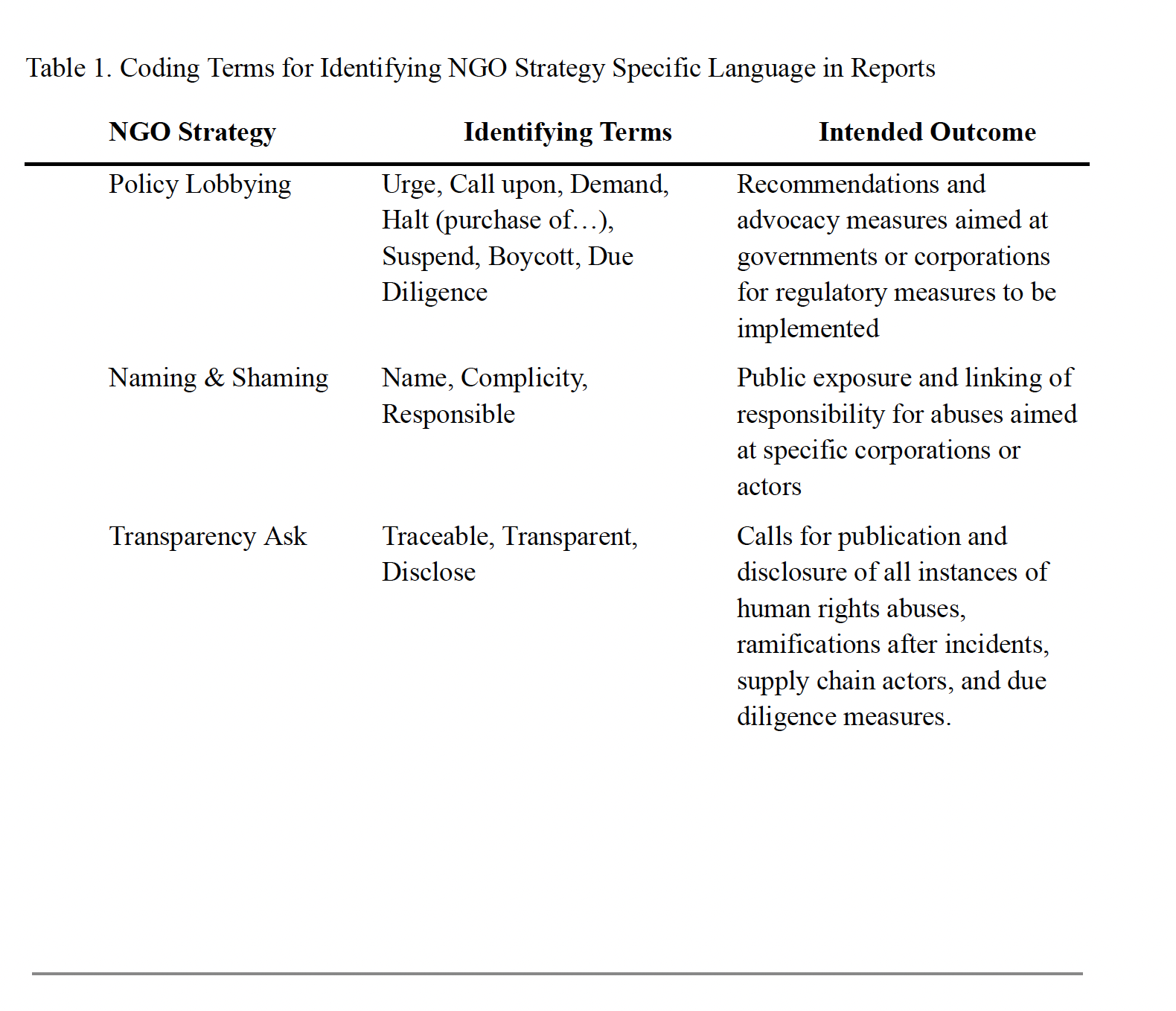
I used these coding terms to locate many of the specific sentences I have in my data collection, but I also analyzed and drew from relevant sections within the reports. I fully read sections relevant to my research and found further examples of my variables, listed in Appendix A, without the coding terms listed in Table 1.
Method
I conducted a comparative case study involving a content analysis of Sierra Leone and the Democratic Republic of Congo. After closely reading and analyzing the NGO reports, I systematically coded examples of NGO strategies and corporate responses. Each NGO strategy quote was labeled and organized under the relevant sub claims based on the independent variable (IV), NGO strategies, which consist of various values, including these categories:
1. ‘Naming/Shaming’
2. ‘Policy Lobbying’
3. ‘Transparency/Traceability Ask’.
In my analysis of corporate responses found within listed NGO reports, I coded examples under the corresponding sub-claims. The sub claims directly correspond to both the IV and it’s values, DVs:
1. ‘Acknowledgment’,
2. ‘Policy Changes’
3. ‘Improved Transparency’.
Building off of Keck & Sikkink's work on transnational advocacy networks and Krain’s expansion on these ideas, I conceptualized the values of my independent variable. Through an inductive process, I operationalized these definitions, finding specific examples in NGO reports to support my claims. ‘Naming’ is the direct identification of a company or government actor as linked to abusive behavior. Indicators of ‘naming’ in NGO reports are seen in mentions of company, government, or organization names. Often seen employed with the ‘naming’ method, ‘shaming’ is the public condemnation/exposure of corporate or government moral violations and failures. The use of moral appeal and language that insinuates someone is a direct cause of a problem indicates ‘shaming,’ such as listing specific incidents which the corporation or government is guilty of, with language like “responsible for…”. ‘Policy lobbying’ terms such as “urge,”,“recommend, “demand,” “call upon”, followed up with recommendations for laws, certifications, or enforcement measures, indicate ‘policy lobbying. ’ ‘Transparency/Traceability ask’ includes calls for publication and disclosure of all instances of human rights abuses, ramifications after incidents, supply chain actors, and due diligence measures. Mentions of “certification, “due diligence,” “public reporting, “supply chain traceability,” “mineral traceability”, and “publication of data” all indicate a ‘transparency ask’ within these reports.
Data Analysis: Results and Findings
Before analyzing the selected NGO reports, I assumed that ‘naming’ and ‘shaming’ would be the most commonly used strategies to achieve transnational mobilization and place pressure on corporations and governments, due to the universal understanding and analysis of this method in other research, like Keck and Sikkink, Bob, and Krain. This existing literature creates a conversation primarily focused on ‘naming and shaming’, which further influenced me to assume this strategy would be the most prevalent. What I found in my research was that the most recurring strategy was ‘policy lobbying’, which was often paired with instances of ‘naming and shaming’ and also ‘transparency asks’. Grounded in the existing academic conversation on NGO strategy and effectiveness, most specifically Keck & Sikkink on transnational advocacy networks and Krain’s work based on their literature, I defined such tactics of ‘naming’, ‘shaming’, ‘policy lobbying’, and ‘transparency asks’ more specifically. ‘Naming’ is the direct identification of a company or government actor as linked to abusive behavior. ‘Shaming’ is the use of moral appeal and language that insinuates someone/something is a direct cause of a problem. ‘Policy lobbying’ is a form of recommendations and advocacy measures aimed at governments or corporations for regulatory measures to be implemented. ‘Transparency/Traceability ask’ includes calls for publication and disclosure of all instances of human rights abuses, ramifications after incidents, supply chain actors, and due diligence measures. More frequently found in the case of Sierra Leone, a specific government actor or corporation name preceded recommendations for policy implementation. Numerous pages of specific and clear policy recommendations were included in all three reports in the Sierra Leone case. In the reports analyzed for the DRC case, naming proved more difficult and less frequent, due to numerous different guilty governments, corporations, and actors. The inability of NGOs to specifically name, revealed the impact of the complex global cobalt supply chain on NGOs abilities to employ the strategy of ‘naming and shaming together.’
Sierra Leone - NGO Reports
In the first report in the Sierra Leone case by Partnership Africa Canada (known as IMPACT today), The Heart of the Matter: Sierra Leone, Diamonds and Human Security. (January 2000) highlighted the severity of the conflict, the extent of the human rights violations, and then used a lot of ‘naming and shaming’ to call out the primary actors fueling the civil war, followed by 7 recommendations to specific actors and De Beers, the world's leading diamond company based out of the UK and South Africa. Specifically naming De Beers framed this issue as a moral crisis, which appeals to consumers and results in consumer awareness. In her 2002 article Diamonds in Peace and War: Severing the Conflict-Diamond Connection, scholar Tamm affirms this report as successful in transnational mobilization by raising global and consumer awareness about the issue and the specific actors involved in the crisis.
The second report by Global Witness, Conflict Diamonds: Possibilities for the Identification, Certification and Control of Diamonds (June 2000) was published in the midst of the international community becoming increasingly aware of the ongoing conflict. The report contains an overview of conflict diamonds and the diamond industry, existing certification schemes in place within similar sectors, and then goes on to recommend a specific certification scheme, followed by more policy lobbying directed at various governments, De Beers and its subsidiaries, and the United Nations. While the end of the civil war in Sierra Leone and full-scale implementation of the Kimberley process did not happen until 2003, the creation and early stages of the Kimberley certification process followed the first two reports. This report and the strategies employed demonstrate that continuous policy lobbying paired with naming was effective in encouraging reform, which is demonstrated in the following report I chose to analyze, which reviews and critiques the beginning stages of KPCS implementation.
The third report, again, by Global Witness, Review of the Sierra Leone Diamond Certification System and Proposals and Recommendations for the Kimberley Process for a Fully Integrated Certification System (FICS). (April, 2001) includes detailed recommendations to the certification system to enhance and strengthen it, following an on-the-ground evaluation of the Kimberley process. The certification system requires rough diamonds to be sealed in tamper resistant containers, with unique identification that assures they were not mined by rebel groups, when crossing international borders all cooperating governments must follow kimberley process guidelines to verify the diamond, in turn lowering the flow of ‘conflict diamonds’ into the global market (Langerman Diamonds Conflict Diamonds and the Kimberley Process Fact Sheet). Overall, Global Witness found the certification system to be working but noted flaws that would hinder its effectiveness. The strategies used were primarily ‘policy lobbying’; however, some of this was found alongside ‘naming’. I found, specifically in this report, that the ‘naming’ and ‘policy lobbying’ tactic effectively shamed the actor that which policy recommendations were targeting by indicating that the policy recommendations should have been previously considered. “However the Ministry of Mineral Resources should also have a system for recording information and for building up a profile of exporters.”. These strategies illustrate the effectiveness of NGO policy lobbying when there is clear government enforcement to implement policy, which contrasts largely with the (later) DRC case. The ‘policy lobbying’ in this report effectively strengthened the certification scheme, which, in its full-scale implementation in 2003, greatly contributed to ending the civil war in Sierra Leone.
Sierra Leone - Conclusions
The analysis of the reports that built my Sierra Leone case shows the use of strategies ‘naming’, ‘shaming’, ‘policy lobbying’, and ‘transparency asks’ by NGOs as successful strategies for fostering transnational mobilization, demanding international cooperation, and making recommendations for strengthened governance. These reports frequently paired strategy ‘policy lobbying’ with ‘naming’, ‘shaming’, and ‘transparency asks.’ The detailed and targeted recommendations to the government of Sierra Leone, relevant actors such as the Ministry of Mineral Resources, De Beers, and adjacent corporations outlined a direct plan and guideline for these actors to follow in their reform efforts. These findings and the response and action from targeted corporations affirms my first sub claim, naming and shaming can trigger corporate reputational responses. The recommendations made to create the KPCS, and then to strengthen it, influenced binding reform, which corporations adopted and mandated. The conventional wisdom that the civil war in Sierra Leone was aided by the KPCS and the enforcement of government actors further affirms a partially successful NGO campaign against conflict diamonds. This conclusion affirms my second subclaim, policy lobbying is most effective when NGOs align with government and IO goals. I acknowledge and support the existing and continued claims that exploitation still exists in the diamond mining industry; however, the KPCS reduced the flow of conflict diamonds into the global diamond market, and still stands as a mandatory certification scheme that diamond corporations must adhere to and implement.
The Democratic Republic of Congo
Building the DRC case and analyzing NGO reports in the same manner as I did for the Sierra Leone reports, I initially concluded that the same exact strategies were used by NGOs, and that the reasoning for the difference in outcomes of effective reform was outside the scope of this research. However, upon closer analysis, reports by Amnesty International (2016) This Is What We Die For, Amnesty International (2017) Time to Recharge, and Bread for All & Swiss Catholic Lenten Fund (2012) Glencore in the Democratic Republic of Congo: Profit Before Human Rights and the Environment revealed the use of direct ‘naming’ and ‘shaming’ was less common than found in the reports I analyzed for the Sierra Leone case. This is largely due to the complexity and number of actors in the cobalt industry. The supply chain is complicated, and cobalt goes through various steps before it is in the hands of more commonly known corporations. Numerous corporations are involved in the extraction of cobalt, and in the process of refining it before sending it off to be turned into batteries. From there, many different companies purchase the batteries and adjacent products for use in their products. This finding directly supports my
Sub-Sub Claim: Various actors and supply chain complexity limit ability to directly employ both naming and shaming strategies together. The reports did name corporations such as Apple, Samsung SDI, Glencore, and Huayou Cobalt, but largely used the broad term “corporations” when ‘shaming’ and giving policy recommendations, “Companies that purchase cobalt, or components containing the mineral, have no excuse for not conducting such due diligence steps…”. (Amnesty International 2016). The generalized blame onto corporations as a whole instead of a specific corporation or actor weakened accountability, limiting the need for corporations to respond to protect their reputation, and hindering outcomes of the ultimate goal: transnational mobilization and reform.
The Democratic Republic of Congo - NGO Reports
The report by NGO’s Bread for All & Swiss Catholic Lenten Fund (2012) Glencore in the Democratic Republic of Congo: Profit Before Human Rights and the Environment exposes Glencore’s behavior in the DRC early on in the discussion of this crisis. Specifically ‘naming’ and ‘shaming’ Glencore's exploitation of child laborers, hazardous working conditions, environmental pollution, and their inaction in amending these wrongs. Various other corporations and subsidiaries of Glencore were ‘named’ and tied to exploitation, however, only Glencore and two of its subsidiaries were directly named in the “recommendations” section, where most of the ‘policy lobbying’ strategy was found. The number of other corporations involved in the extractive industry in the DRC exposes how complex the cobalt supply chain is.
In Amnesty International’s (2016) This Is What We Die For report, their findings are mainly framed through the strategies of ‘shaming’ and ‘policy lobbying’ urging companies in general to take responsibility for child labor and unsafe working conditions, and implementing due diligence, “Companies should undertake and publicly disclose their due diligence practices.” (70); “Conduct supply chain due diligence for cobalt and other minerals and publicly disclose their due diligence policies and practices in accordance with international standards” (70). The lack of specificity presents an avenue for corporate response and action to be symbolic, while they go on to name Apple as a downstream buyer of cobalt, they provide only a partial response, “Apple did not directly answer Amnesty International’s questions regarding its purchasing of components or products containing cobalt that has been processed…‘Currently evaluating dozens of different materials, including cobalt, to identify labor and environmental risks as well as opportunities for Apple to bring about effective, scalable, and sustainable change.” (59). These symbolic responses mean there are limited on-the-ground changes occurring, if any at all. The companies that chose to respond partially in the investigation fell short of any due diligence, increased transparency, or remediation efforts.
Amnesty International’s (2017) follow-up report, Time to Recharge reinforced these strategies but emphasized ‘transparency asks’ and ‘policy lobbying’. The report calls out continued symbolic measures by corporations, and the lack of binding frameworks or due diligence measures in place in the industry: “Though many companies have joined voluntary industry-led initiatives to address human rights risks associated with cobalt and other raw materials, none are currently disclosing specific human rights risks or abuses identified in their supply chains.” (10). It is drawn as a conclusion that even specifically named companies, such as Apple and Samsung SDI, have joined voluntary frameworks yet there is still an absence of binding transparency, “While it may be useful for companies to join these initiatives, they cannot simply point to their membership of the RCI Responsible Cobalt Initiative) or the RMI (Responsible Mineral Initiative) as evidence that they are addressing risks in their supply chains. As international standards make clear, companies always maintain an individual responsibility to respect human rights in their supply chains.” (70) Without improved transparency and due diligence practices, it becomes difficult for NGOs to measure overall improvement.
The Democratic Republic of Congo - Conclusions
Although similar strategies were employed by NGOs to foster transnational cooperation and mobilization surrounding the issue of cobalt mining, corporate action remained either non-existent or symbolic. It is important to note that “Huayou Cobalt, the company at the centre of ‘This is What We Die For’, has acknowledged the need to improve its ASM cobalt sourcing practices so that these comply with international standards. This is significant…adopted new supplier due diligence policies…initial steps towards more responsible sourcing of ASM cobalt by CDM…willing to seek solutions to identified human rights issues in its supply chain… this is a starting point.” (Amnesty International 2017, 80). In my analysis of the DRC case, it is clear that the global supply chain complexity results in mixed outcomes of NGO strategies. The global cobalt supply chain begins in the DRC, in the hands of children and forced laborers. Over 90% of these operations are owned by Chinese companies, who, before export to China, mix and refine cobalt from multiple sources, making it impossible to identify the sources of the cobalt.
From China, the rest of the world purchases and imports the primary component for lithium-ion batteries, used to power electric vehicle batteries and electronics such as Apple iPhones, which inherently increases the demand for the mineral as the world transitions to “renewable energy” (The Department of Labor’s Exposing Exploitation in Global Supply Chains Series). This complex supply chain causes difficulties in identifying the leading perpetrators, which leads NGOs to pair the ‘naming’ tactic less directly with ‘shaming’; instead, they use the broad term “corporations”. The large number of corporations involved changes the dynamics of ‘naming and shaming’ employed, which resulted in few to no corporate responses, and inherently no notable action in the cobalt mines. The symbolic responses from corporations in this case support my third sub claim, transparency asks expose the limits of voluntary frameworks and corporate social responsibility. I conclude that the complexity of the global cobalt supply chain has a direct impact on the effectiveness of these NGO strategies, negatively impacting the goals of NGOs.
Comparison
Comparing the Sierra Leone and DRC cases reveals the importance of context in shaping NGO effectiveness. In both cases, the same strategies of ‘naming’, ‘shaming’, ‘policy lobbying’, and ‘transparency asks’ were employed due to the similar nature of both being human rights crises within artisanal mining sectors. In the Sierra Leone case, NGO strategies and demands aligned with transnational interests. The nature and severity of the conflict yielded a larger response from the international community, and international organizations and governments were ready to act. The clear development and guidelines of the Kimberley Process Certification Scheme (KPCS) and the readiness of the international community led to the successful implementation of the certification process, which resulted in a significant reduction in the flow of conflict diamonds into the global market. The same strategies produced little to no change in the DRC case. The lack of a successful consumer campaign limited transnational mobilization and, therefore, limited change. The complexity of the global cobalt supply chain, increasing market demand for cobalt, and a lack of government and international community goals aligning with NGO goals directly impacted the outcome of NGO strategies. This finding strongly supports my sub cub claim, under sub claim 1, that various actors and supply chain complexity limit ability to directly employ both naming and shaming strategies together, which in turn hinders effectiveness. While both cases largely relied on transnational mobilization and used the same strategies to achieve it, only the Sierra Leone case demonstrated that NGO pressure can translate into successful reform.
I also concluded based on my findings that the degree of demand for these minerals plays into outcomes. NGOs in the Sierra Leone case directly named and then shamed luxury diamond corporations, which is not a necessary or widely implemented item into individuals' regular daily lives. This successfully aided in the campaign by raising global awareness about the conditions and consequences that the mining of diamonds inflicts. On the other hand, cobalt is widely used in modern technologies that most individuals do not have much knowledge of the components that make their iPhones, MacBooks, and vehicles which they depend on every day. The purchasing and wearing of an expensive, naturally mined diamond attracts attention, and a consumer can be directly called out by their role in supporting a corporation which exploits laborers and fuels an ongoing conflict. Cobalt in cell phones and electronics is much less visible, and in turn causes less individual guilt associated with owning one. Most people own some sort of technology containing cobalt, which hinders personalized shaming and guilt. There is irony in my writing of this thesis, as I did so on an Apple MacBook, which contains a lithium-ion battery most likely containing cobalt mined in the DRC. This difference in accessible knowledge and consumer choices in purchasing these products results in differing outcomes: more success in the conflict diamond campaign and less success in the cobalt campaign.
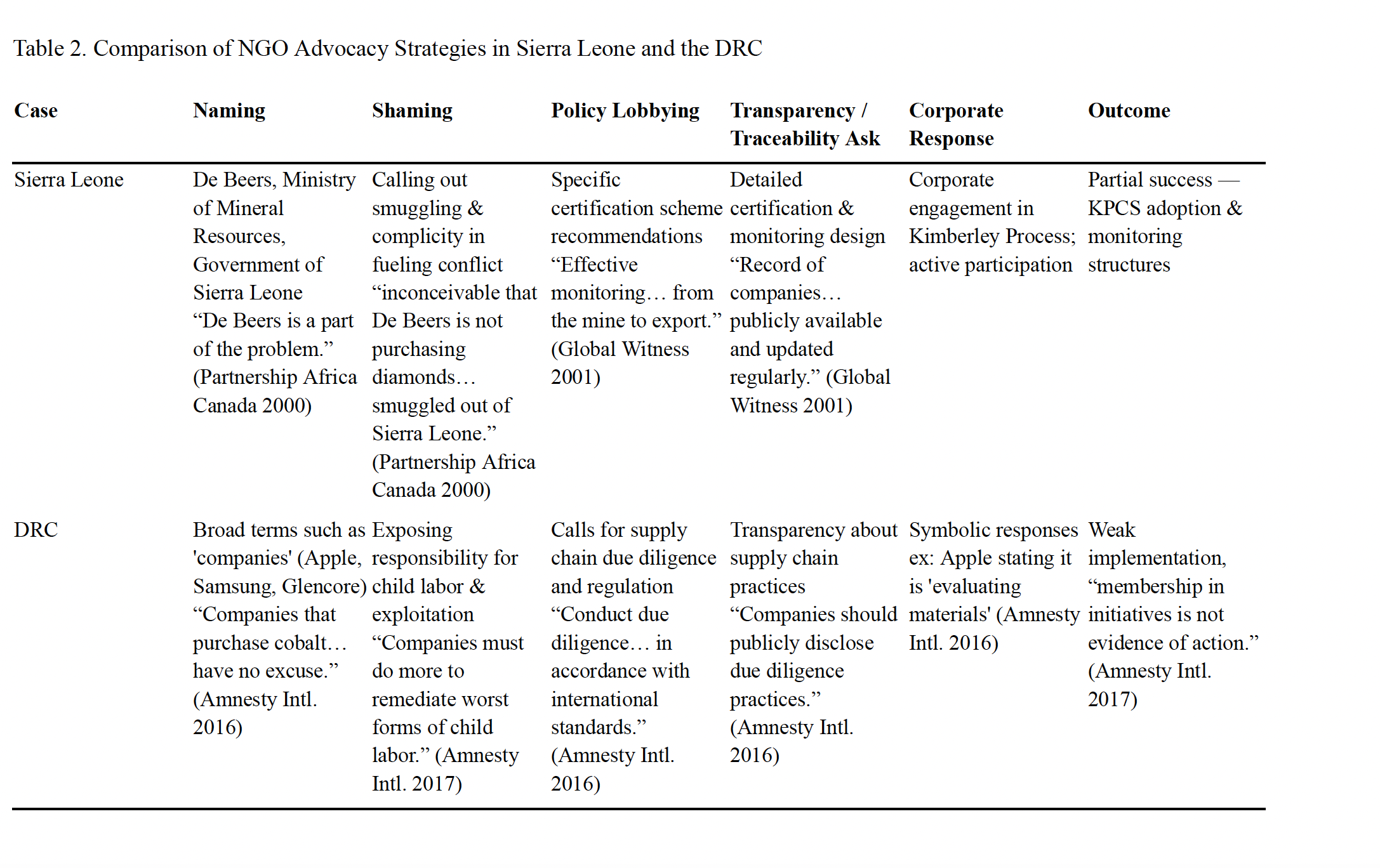
To further compare the difference in outcomes in these cases, Table 2 summarizes the use of NGO strategies, the target/framing, and provides relevant evidence. This further displays how similar NGO strategies have differing outcomes. The difference in framing further brings to light the difficulty in identifying specific actors in the complex cobalt supply chain, making it difficult for NGOs to more specifically expose them. This table also reaffirms the difference in responses and outcomes in both cases. Sierra Leone received more response and direct involvement in reform from relevant corporations, specifically De Beers, which resulted in more successful reform. Whereas the DRC case received little response and merely symbolic actions from corporations, which has resulted in no policy reform and no measurable success.
Table 2. Comparison of NGO Advocacy Strategies in Sierra Leone and the DRC
Discussion
This comparative analysis displays and defines specific strategies employed by NGOs in order to influence reform in African extractive industries, specifically diamonds in Sierra Leone and Cobalt in the DRC. The findings of this research highlights the difference in outcomes between these cases, which lead to my conclusion that other factors outside of NGO involvement have an impact on effectiveness of NGO strategies. Effectiveness depends heavily on how NGO strategies align with international interests, government structures and capabilities, consumer characteristics, and supply chain logistics. NGOs Partnership Africa Canada, Global Witness, Bread for All & Swiss Catholic Lenten Fund, and Amnesty International utilized identical advocacy strategies ‘naming’, ‘shaming’, ‘policy lobbying’, and ‘transparency asks’, but these strategies yielded significantly different outcomes in my comparative case study.
In the Sierra Leone case, direct and repetitive naming of key corporate actors, most notably De Beers, increased pressure onto the companies reputation and helped to mobilize transnational actors to understand the direct link between conflict diamonds and widespread abuse in Sierra Leone. This luxury industry was very narrow and had a easy to understand supply chain which made it easier for NGOs to identify and pressure actors complicit in the industries continued exploitation. Globally, there was widespread support from governments and international organizations to intervene and enforce reform efforts and create policy to help end the abuses linked to the diamond industry. The available knowledge about the abusive conditions diamond mining was creating made it easy for consumers to understand the effects of purchasing diamonds and supporting relevant corporations. It became clear to consumers, through NGO framing, that diamonds were fueling a devastating civil war, and consumers had a clear choice of what to support. This campaign made clear that diamonds are not a necessary materialistic object, but a luxury that was not worth thousands deaths in Sierra Leone. The alignment and successful transnational mobilization of advocacy networks, as highlighted by Keck & Sikkink, resulted in these NGO strategies culminating in a concrete and lasting certification scheme which helped to lessen the problem NGO campaigns centered their focus around.
In contrast, the DRC case highlights the limits of these NGO strategies when international and governmental interests, consumer knowledge, and supply chain logistics do not align with the goals of NGOs. NGOs Amnesty International and Bread for all & Swiss Catholic Lenten Fund used the same strategies of naming, shaming, policy lobbying, and transparency asks but faced challenges in highlighting and shaming specific relevant corporations. The cobalt supply chain is vast, and hard to track, with various actors spread out across various locations in the world and in different market such as, electric vehicles, modern technology, software, etc…This complexity gives corporations an avenue to deflect blame and accountability. This deflection of accountability is seen in symbolic actions, such as verbally supporting initiatives to address and fix human rights violations within the industry, but no concrete plan on implementationa and reporting. When corporations did choose to respond, the responses were superficial and mentioned voluntary corporate social responsibility initiatives that are not binding and have no concrete implications or accurate reporting. Without cooperating international enforcement and consumer pressure, these NGO strategies do not result in concrete and structural reform efforts.
Expanding on this point, weak governance in the DRC, a country often labeled as a ‘failed state’ further reduces the effectiveness of NGO strategies. Without a functioning government with clear objectives, citizens are left vulnerable to forced and child labor and the country itself vulnerable to exploitation of its natural resources. When international organizations and governments came to support reform in Sierra Leone, support for it’s government helped to bring these NGO strategies to operation, resulting in genuine reform through the KPCS. The DRC case saw limited global and governmental response and support, which further affirms the need for a stable and prepared government, and support from international actors to achieve meaningful reform.
These cases show that NGO strategies are most effective when supported by government and international interests, consumer support, and a simple supply chain. These factors allow for accountability to take place, governments and organizations to enforce reform efforts and consumers to make informed decisions about supporting a corporation and product. When these conditions are not present the same strategies fail to produce successful reform.
Further research could analyze the strategies defined in my thesis applied to different cases of human rights violations within extractive industries to further examine the connection between supply chain complexity and NGO campaign effectiveness. As the demand for cobalt increases with the current interest in electric vehicles and creation of new modern technologies, this problem in the DRC persists. Expanding this discussion on the effectiveness of NGO strategies in the DRC could reveal which ways NGOs could alter campaigns centered around this issue, and hopefully help to end exploitation in the DRCs cobalt mining industry. One day, the academic discussion surrounding exploitation in extractive industries and NGO involvement can hopefully lead to the end of exploitation and human rights abuses.
Conclusion
This thesis aimed to answer what explains the variations in the successes and failures of NGOs to effectively pressure corporations to address human rights violations in the mineral mining industries in Sierra Leone and the DRC. By conducting a content analysis of NGO reports to build a case on both Sierra Leone and the DRC, and then constructing a comparative study I was able to analyze and define NGO strategies such as naming, shaming, policy lobbying, and transparency asks. This study successfully answered the question of why are there variations in successes and failures of NGO campaigns in Sierra Leone and the DRC, concluding that international and governmental interests, consumer knowledge, and supply chain complexity influence outcomes of NGO strategies.
In Sierra Leone, targeted naming, clear shaming and indication of who is responsible, and continued and specific policy lobbying mobilized transnational support. This mobilization resulted in the creation and implementation of the Kimberly Process Certification Scheme. This certification scheme helped to significantly reduce the flow of conflict diamonds into the global market, helping to end the civil war and create lasting policy which the industry must adhere to and enforce. Although this system still has its flaws, and exploitation persists, the outcome of NGO strategies was a measurable success.
In the DRC, the same strategies did not result in a measurable success. The complexity of the supply chain, a lack of consumer mobilization, and limited international and governmental support directly impacted the effectiveness of strategies naming, shaming, policy lobbying, and transparency asks. Corporate responses were limited and remained symbolic, mainly addressing and mitigating risks to their reputations, and voluntary agreements lacked enforcement and transparency. This results in continued human rights abuses and hazardous mining conditions within the DRCs cobalt mining sector.
The findings of this research emphasizes the necessity of NGOs strategic campaigns, but that they cannot yield effective reform if outlying factors do not align with campaign goals. NGO strategies have the strongest influence on successful reform when NGOs can concretely name and shame corporations within the supply chain, and specifically call upon international organizations, governments and consumers to support reform efforts. When these outlying factors are not available, NGO campaigns produce awareness but lack the faculties to enforce anything but symbolic reform.
References
Amnesty International. This Is What We Die For: Human Rights Abuses in the Democratic Republic of the Congo Power the Global Trade in Cobalt. London: Amnesty International, 2016.
Amnesty International. Time to Recharge. London: Amnesty International, 2017.
Bieri, Franziska. 2010. From Blood Diamonds to the Kimberley Process : How NGOs Cleaned up the Global Diamond Industry. Oxford: Taylor & Francis Group. Accessed September 18, 2025. ProQuest Ebook Central.
Bratton, Michael. 1987. “The Politics of Government–NGO Relations in Africa.” Institute of Development Studies Discussion Paper 240.
Bread for All & Swiss Catholic Lenten Fund. Glencore in the Democratic Republic of Congo: Profit Before Human Rights and the Environment, April 2012.
Calvão, Filipe, Catherine Erica Alexina McDonald, and Matthieu Bolay. "Cobalt Mining and the Corporate Outsourcing of Responsibility in the Democratic Republic of Congo." The Extractive Industries and Society 8, no. 4 (2021): 100884.
Campbell, Bonnie. 2006. “Good Governance, Security and Mining in Africa.” Minerals & Energy – Raw Materials Report 21 (1): 31–44.
Clifford, Bob. 2001. “Marketing Rebellion: Insurgent Groups, International Media, and NGO Support.” International Politics (Basingstoke, United Kingdom) 38 (3): 311–34.
Dingwerth, Klaus. 2008. “Private Transnational Governance and the Developing World: Comparative Perspective.” International Studies Quarterly 52 (3): 607–34.
Geenen, Sara, and Ben Radley. "In the Face of Reform: What Future for ASM in the Eastern DRC?" Futures 62, Part A (2014): 58–66.
Global Witness. Conflict Diamonds: Possibilities for the Identification, Certification and Control of Diamonds. London: Global Witness, June 2000.
Global Witness. Review of the Sierra Leone Diamond Certification System and Proposals and Recommendations for the Kimberley Process for a Fully Integrated Certification System (FICS). London: Global Witness, 2001.
Mazalto, Marie. "Governance, Human Rights and Mining in the Democratic Republic of Congo." In Mining in Africa: Regulation and Development, edited by Bonnie Campbell, 187–242. New York: Pluto Press, 2010.
Handelsman, Simon. 2002. "Human Rights in the Minerals Industry." In Mining, Minerals, and Sustainable Development. London: International Institute for Environment and Development.
Howard, Audrie. "Blood Diamonds: The Successes and Failures of the Kimberley Process Certification Scheme in Angola, Sierra Leone, and Zimbabwe." Washington University Global Studies Law Review (2016) 15:137–160.
Idemudia, Uwafiokun, Francis Xavier D. Tuokuu, and Marcellinus Essah. "The Extractive Industry and Human Rights in Africa: Lessons from the Past and Future Directions." Resources Policy 78 (2022).
Kang, Jiyun, and Greta Hustvedt. 2014. “Building Trust Between Consumers and Corporations: The Role of Consumer Perceptions of Transparency and Social Responsibility.” Journal of Business Ethics 125 (2): 253–65.
Keck, Margaret E., and Sikkink, Kathryn A.,1998. Activists Beyond Borders : Advocacy Networks in International Politics. Ithaca: Cornell University Press. Accessed September 18, 2025. ProQuest Ebook Central.
Kinley, David, and Junko Tadaki. "From Talk to Walk: The Emergence of Human Rights Responsibilities for Corporations at International Law." Virginia Journal of International Law (2004) 44 (4): 931–1023.
Krain, Matthew. 2012. “J’accuse! Does Naming and Shaming Perpetrators Reduce the Severity of Genocides or Politicides?” International Studies Quarterly 56 (3): 574–89.
Le Billon, Philippe. 2001. “The Political Ecology of War: Natural Resources and Armed Conflicts.” Political Geography 20 (5): 561–84.
Mària, Josep F., SJ, and Miho Taka. "The Human Rights of Artisanal Miners in the Democratic Republic of the Congo: The Responsibility of Mining Companies." African Journal of Economic and Management Studies ( 2012): 137–150.
Partnership Africa Canada (now IMPACT). The Heart of the Matter: Sierra Leone, Diamonds and Human Security. Ottawa: Partnership Africa Canada, 2000.
Santoro, Michael A. "Introduction: Business and Human Rights in Historical Perspective." Journal of Human Rights 14 (2015): 155–161.
Sarfaty, Galit A., and Raphael Deberdt. “Supply Chain Governance at a Distance.” Law & Social Inquiry 49, no. 2 (2024): 1036–1059.
Sovacool, Benjamin K. "The Precarious Political Economy of Cobalt: Balancing Prosperity, Poverty, and Security in the Democratic Republic of the Congo." Resources Policy (2019) 64: 101449.
Sovacool, Benjamin K. "When Subterranean Slavery Supports Sustainability Transitions?
Power, Patriarchy, and Child Labor in Artisanal Congolese Cobalt Mining." The Extractive Industries and Society (2021): 271–293.
Tamm, Ingrid. 2002. Diamonds in Peace and War: Severing the Conflict-Diamond Connection. Cambridge, MA: World Peace Foundation.
Umpula, Emmanuel, and Mark Dummett. “The Blood Cobalt Narrative: Addressing Human Rights Concerns or Scaremongering?” Business and Human Rights Journal 9, no. 2 (2024).
Vines, Alex and Tom Cargill. "The Impact of UN Sanctions and their Panels of Experts." International Journal 65, no.1 (2010): 45-67.
Winston, Morton E. 2002. “NGO Strategies for Promoting Corporate Social Responsibility.” Ethics & International Affairs 16 (1): 71–87.
Appendix A.
NGO Report Evidence Supporting Strategies
Sub Claim I: ‘Naming’ and ‘Shaming’ can trigger reputational responses from corporations.
- Case: SL - Global Witness (2000):
- “The UN urgently needs to tackle the problems of the RUF (Revolutionary United Front - rebel group mining diamonds in SL) generating continued revenue from diamonds. Despite deploying the largest force in its history as of February 2000, it did not have a single member of staff responsible for monitoring diamonds.” pg. 4
- “Whilst it is repeatedly stated by De Beers that they may never have directly purchased diamonds from Unita, this is a complete abdication of corporate responsibility” pg. 14
- Case: SL - Partnership Africa Canada (now IMPACT) (2000):
- “De Beers mines or partners in mining the majority of the world’s diamonds, it purchases by far the majority of all diamonds produced, and more or less sets the global price of rough diamonds on international markets. Probably its major role, and a role in which it has been extremely successful, is to maintain stable prices by manipulation of both the supply and demand for rough diamonds on world markets. This is done through its Central Selling Organization (CSO)” 3.2 pg. 21
- “De Beers is part of the problem. In its efforts to control as much of the international diamond market as possible, it is no doubt purchasing diamonds from a wide variety of dubious sources, either wittingly or unwittingly.” pg. 30
- “As a matter of urgency, more rigorous oversight on the issue of origin must be instituted by the CSO.” pg. 72
- “De Beers says that it does not purchase Sierra Leonean diamonds. Through its companies in several West African countries, however, and in its attempts to mop up supplies everywhere, it is virtually inconceivable that De Beers is not purchasing diamonds that have been smuggled out of Sierra Leone.” pg. 26
- “De Beers further affirms that it is impossible to verify the country of origin for a diamond, but they are shareholders and own 90% of the companies involved in the mining/ exportation of diamonds.” pg. 26
- Case: SL - Global Witness (2001): Please note there were no page numbers in this publication
- Section 2: Ministry of Mineral Resources
- “However the Ministry of Mineral Resources should also have a system for recording information and for building up a profile of exporters.”
- “The Ministry of Mineral Resources needs to develop clear written policy guidelines for the allocation of export licences…needs to produce a definitive record of individuals and companies that have paid for, and hold, an export licence…needs to give more information to the MMOs to help them improve their monitoring capacity, and to generally improve the information flow between the head office and the regions.”
- Section 4: Importing Governments
- “To date the following countries have received exports of diamonds from Sierra Leone under the certification system – Belgium, the UK, the USA and Israel…only Belgium is appropriately equipped to handle the imports of these diamonds…”
- Case: DRC Amnesty International (2017)
- “Even Apple and Samsung SDI, which are showing partial compliance with the relevant transparency standards, have not yet disclosed details of their assessments of their smelters’ and refiners’ due diligence, including specific details of any risks or impacts that were identified.” pg. 68
- “Amnesty International believes that downstream companies are not demonstrating that they are identifying, preventing, and addressing human rights abuses in line with the UN Guiding Principles and OECD Guidance.” pg.67
- “Almost two years after Amnesty International first revealed the scale of the problem, none of the 29 companies named in this report are carrying out human rights due diligence on their cobalt supply chains in line with international standards. This is despite knowledge that human rights risks and abuses are intrinsically linked to cobalt mining in the DRC . . . . Huayou Cobalt, the company at the centre of This is What We Die For, has acknowledged the need to improve its ASM cobalt sourcing practices so that these comply with international standards. This is significant. Huayou Cobalt has adopted new supplier due diligence policies and taken initial steps towards more responsible sourcing of ASM cobalt by CDM. It has stated it is willing to seek solutions to identified human rights issues in its supply chain, rather than simply carrying on business as usual. While serious concerns continue to exist in its supply chain, this is a starting point.” (pg. 80)
- Case: DRC Bread for All & Swiss Catholic Lenten Fund (2012):
- Response from Glencore regarding Luili river pollution impacting local communities:
- “Glencore also claims that it inherited the situation from Gécamines: Corporate Response (DV)"The Luilu operations have been disposing of untreated waste water into the Luilu river ever since operations began over 50 years."
- It equally minimises its responsibility, saying that the pollution is also the result of artisanal miners, working down-stream.” pg. 27
Sub-Sub Claim: Various actors and supply chain complexity limits ability to directly employ both naming and shaming strategies together
- Case: DRC Amnesty International (2016):
- “Companies that purchase cobalt, or components containing the mineral, have no excuse for not conducting such due diligence steps…the poor conditions of its artisanal mines, and the presence of children working in them, has been reported publicly in the past.” pg. 9
- “Apple did not directly answer Amnesty International’s questions regarding its purchasing of components or products containing cobalt that has been processed…”
- Apple response to Amnesty International questioning:
- ‘Currently evaluating dozens of different materials, including cobalt, in order to identify labor and environmental risks as well as opportunities for Apple to bring about effective, scalable and sustainable change.’” pg. 59
- Case: DRC Amnesty International (2017):
- “Business as usual is not an option: it is time for companies to “recharge their batteries” and face up to their human rights responsibilities in their cobalt supply chains” pg. 11
- “So far, only Apple and Samsung SDI, two of the companies that have gone the furthest in investigating their supply chains, have publicly disclosed the names of their smelters and refiners. Most downstream companies have not made enough progress in investigating their supply chains to publish this sort of information.” pg 68
- “While it may be useful for companies to join these initiatives, they cannot simply point to their membership of the RCI or the RRMI as evidence that they are addressing risks in their supply chains. As international standards make clear, companies always maintain an individual responsibility to respect human rights in their supply chains.” pg. 70
Sub Claim II: Policy Lobbying is most effective when NGOs align with Government and IO goals
- Case: SL - Partnership Africa Canada (now IMPACT) (2000):
- “the overall security of the country, including the diamond areas, must be provided by the Government of Sierra Leone. International support in making this possible is an urgent priority.” pg. 63
- “Strong efforts should be made by the Government of Sierra Leone, international bodies such as the United Nations and the World Bank, and concerned governments, to persuade De Beers to return to Sierra Leone. At a minimum, De Beers should be persuaded to open a purchasing office in Freetown and should be given every incentive to do so.” pg. 72
- “The Government of Belgium must take full and direct responsibility for oversight of the Belgian diamond industry. This includes taking direct responsibility for customs, valuation and statistical procedures.” pg. 72
- “One way of drawing greater attention to the urgency of the matter and of gaining broader support for change, would be a consumer campaign, One has already been started in Europe* and it would not be difficult to expand it. Imagine: • Diamonds are not a girl’s best friend - witness the brutalized little girl (pictured on the cover of this report) with no hands; • ‘The millennium gift she’ll never forget’ - ditto; • For some people, diamonds are more ‘forever’ than for others - witness 75,000 violent deaths in Sierra Leone; • Diamonds are a guerilla’s best friend - witness Sierra Leone’s coups, rampaging criminals, etc etc” pg. 75
- Case: SL - Global Witness (2000):
- “Every country has technical requirements for the import and export of goods and services…there is an urgent requirement of governments, policy makers and trade bodies to monitor and regulate the trade in these associated industries to ensure that they do not contribute to the funding of conflict.” pg. 27
- “An important and urgent first step would be for the diamond trade to set up an industry taskforce or reform committee to immediately begin working on the issue.” pg. 42
- Case: SL - Global Witness (2001): Please note there were no page numbers in this publication
- Section: Recommendations
- “Effective monitoring by a government agency from the mine to the point of export.”
- “It is in fact self evident that unless the exporting Government can exercise detailed oversight over the whole system it is very difficult to fully authenticate the flow of diamonds from the export office and to authenticate any accompanying certification.”
- “The principal of government oversight from the mine to the point of export is and will be an integral part of a successful international certification system and should be widely encouraged as part of the Kimberley process recommendations.”
- “Creation of an independent conflict diamond experts panel to assist individual governments with identification of suspect stones….Publication of official export data on a regular basis for all diamond exporting and producing countries.”
- Section 2: Ministry of Mineral Resources
- “However the Ministry of Mineral Resources should also have a system for recording information and for building up a profile of exporters.”
- “The Ministry of Mineral Resources needs to develop clear written policy guidelines for the allocation of export licences…The Ministry of Mineral Resources needs to produce a definitive record of individuals and companies that have paid for, and hold, an export licence. This record should be publicly available and should be updated on a regular basis…The Ministry of Mineral Resources needs to give more information to the MMOs to help them improve their monitoring capacity, and to generally improve the information flow between the head office and the regions.”
- Section 4: Importing Governments
- “It is important that importing governments play as active a role in combating conflict diamonds as that being played by producing countries.”
- Section 5: Conclusion
- “This briefing document has sought to make recommendations to help the system develop and to strengthen it against conflict/illicit diamonds.”
- Case: DRC Amnesty International (2016):
- “The government of the DRC should create more ZEAs (Zones d’Exploitation Artisanale - roughly translates to anti-exploitative artisanal mining zones, aimed to formalize activities of informal miners) and regularise unauthorized mining areas,...It urgently needs to put in place an adequate system to monitor and enforce the labour standards that exist, including on the worst forms of child labour.” pg. 10
- “Companies should undertake and publicly disclose their due diligence practices.” Pg. 67
- “Conduct supply chain due diligence for cobalt and other minerals and publicly disclose their due diligence policies and practices in accordance with international standards” pg. 70
- “Regularize unauthorized mining areas, where this is possible taking into account safety and policy considerations. Where this is not possible, support artisanal miners in moving to other authorized sites and help create alternative employment options.” pg. 68
- “Legally require companies to conduct human rights due diligence on their mineral supply chains, and report publicly on their due diligence policies and practices in accordance with international standards.” pg. 69
- Case: DRC Amnesty International (2017):
- “This means that it is more urgent than ever that companies improve their due diligence practices to ensure respect for human rights.pg. 11
- “where harm has occurred, companies must do more to remediate the worst forms of child labour if they have contributed to and benefitted from it. Companies should build upon the CEGA findings and implement effective measures immediately, with clear goals that reflect the seriousness and urgency of the child labour problem.” pg. 25
- “Companies that use cobalt should report formally, regularly and publicly on the actions taken to identify, prevent or mitigate human rights risks and address actual harms to be fully in line with international standards…In addition to publishing the identities of smelters and refiners, it is essential that companies also report on their assessments of the due diligence practices of their smelters and refiners.” pg. 67
- Corprate Responses (DV):
- “Many of the consumer-facing companies in the electronics and automotive industries responded to questions about mitigation and remediation by mentioning that they were taking part in one or more of the joint industry initiatives that have recently emerged, such as the RCI or the RRMI. While it may be useful for companies to join these initiatives, they cannot simply point to their membership of the RCI or the RRMI as evidence that they are addressing risks in their supply chains. As international standards make clear, companies always maintain an individual responsibility to respect human rights in their supply chains.” pg. 70
- “General Motors reported that training on sustainability issues, including child labour, was being provided to direct suppliers through the Automotive Industry Action Group (AIAG),259 but there was no indication that this included any special focus on issues related to the cobalt supply chain. Fiat-Chrysler said that it led the formation of a Cobalt/Mica Working Group within the AIAG to help promote applicable standards to relevant suppliers. BMW said that it holds regular sustainability workshops with its first-tier suppliers during which it discusses “all relevant issues on human rights/social standards and risk management within the supply chain” and that it has taken part in at least one such workshop focused on issues related to cobalt. It is unclear at this stage whether any of these supplier training efforts have actually led to better due diligence over cobalt supply chains.” pg. 71
- Case: DRC Bread for All & Swiss Catholic Lenten Fund (2012):
- “The process for the elaboration of these studies must be based on an open and transparent consultation. The law demands that the firm organise information sessions to explain to the population the exploitation project, the work undertaken, the projected impact, the environmental consequences, etc” pg. 43
Sub-Claim III: Transparency/Traceability asks expose the limits of voluntary frameworks and corporate actions
- Case: SL - Partnership Africa Canada (now IMPACT) (2000):
- “As a matter of urgency, more rigorous oversight on the issue of origin must be instituted by the CSO.” p.72
- “The Government of Sierra Leone must ensure full transparency, high standards and rigorous probity in the implementation of its diamond purchasing, evaluation and oversight activities. Corruption and conflicts of interest must be dealt with quickly and decisively. There is an important role to be played in this effort by Sierra Leonean civil society. Assistance in reviewing current systems and developing an enforceable code of conduct should be sought from appropriate donor agencies.” pg. 71
- Case: SL - Global Witness (2000):
- “Global Witness asked the major exporters and importers of diamonds to clarify their procedures and requirements for the trading of diamonds. The picture that emerges, overall, is one of few requirements for Certificates of Origin (COs) relating to diamonds. Although import and export documents require exporter, importer and origin information as standard, there are various loopholes in the system with regard to defining the origin of goods.” pg. 24
- Case: SL - Global Witness (2001): Please note there were no page numbers in this publication
- Recommendation Section
- “Publication of data on official exports on a regular basis. Publication of manual or handbook of information for exporters, dealers and miners. Implementation of anti-corruption programs.”
- “For a successful system of controls to be in operation it is imperative that all stakeholders are aware of developments and issues relating to their work.”
- “The Ministry of Mineral Resources needs to develop clear written policy guidelines for the allocation of export licences…The Ministry of Mineral Resources needs to produce a definitive record of individuals and companies that have paid for, and hold, an export licence. This record should be publicly available and should be updated on a regular basis…The Ministry of Mineral Resources needs to give more information to the MMOs to help them improve their monitoring capacity, and to generally improve the information flow between the head office and the regions.”
- Case: DRC Amnesty International (2016):
- “Companies should undertake and publicly disclose their due diligence practices.” Pg. 67
- “Conduct supply chain due diligence for cobalt and other minerals and publicly disclose their due diligence policies and practices in accordance with international standards” pg. 70
- “Publicly disclose the steps taken to identify, assess and mitigate human rights risks and abuses in its business operations.” pg.70
- Case: DRC Amnesty International (2017):
- “These should include details of the effectiveness of any systems in place to trace mineral supplies back to their source, map supply chains and identify the conditions of extraction and trading. A crucial element of public reporting should be the disclosure of the actual or potential human rights abuses.” pg. 67
- Case: DRC Bread for All & Swiss Catholic Lenten Fund (2012):
- “The process for the elaboration of these studies must be based on an open and transparent consultation. The law demands that the firm organize information sessions to explain to the population the exploitation project, the work undertaken, the projected impact, the environmental consequences, etc” pg. 43