Jaclyn Deborah Dziadose
Abstract
There is general agreement that polarized debate and speech is negative, but how do we differentiate this from healthy democratic debate? To answer this question I develop indicators for political polarization and healthy democratic debate based on a careful reading of the literature on polarization. I then apply these indicators in a content analysis of op-eds from major British newspapers to determine the extent to which the Brexit debate was characterized by polarized debate or healthy democratic debate. While op-eds contained both polarizing and democratic traits, I found they exhibited more indicators of political polarization than healthy debate. By studying the rhetoric used in a major issue like Brexit, we can better understand the nature of polarization in developed democracies, so that problematic politics can be distinguished from healthier forms of political discussion.
Introduction
To what extent does the newspaper debate about Brexit in the U.K. exhibit traits of political polarization versus healthy democratic debate? In the past few decades, political polarization, or the movement of political ideologies further towards extremes and away from moderate views among voters and political parties, has been studied in many developed democracies. Among these nations, there have been numerous political events that have unfolded. For instance, Brexit, which consisted of years of political activity and discussion, was a major political event for the United Kingdom that drew national and international attention. To answer my research question, I built upon scholarly discussions of polarization and healthy debate and analyzed the Brexit debate as covered in opinion pieces and editorials in U.K. newspapers. I developed key indicators of political polarization and healthy democratic debate and applied them to the Brexit debate and the content of op-eds in U.K. newspapers. I analyzed the political language and rhetoric used in different op-eds from U.K. newspapers. I evaluated how these individual op-eds are examples of political polarization, healthy democratic debate, or a mix of both. I claimed that my content analysis of op-eds will show that the newspaper debate about Brexit within the U.K. is a case of political polarization more than healthy political discussion. My findings show that the op-eds do exhibit more political polarization and support my hypothesized claim. Through analyzing op-eds focusing on the Brexit debate, I strive to produce a better understanding of the nature of political polarization in prominent democracies of our world such as the U.K., so that problematic politics can be distinguished from healthier forms of political discussion. With my research, I aim to clarify ways in which political polarization can be detected within a country’s media, so that they might be applied to developed democracies and their political atmospheres and issues. Essentially, my analysis is an exercise in theory-building, as it will help us better conceptualize what polarization really is.
Literature Review
In order to better understand polarized and healthier discourse, it is important to know how polarization and its several forms are conceptualized. Scholars have discussed various types and kinds of polarization, reflecting the complexity of studying different definitions of polarization in democracies (Schedler 2023; McCoy & Somer 2021; Harteveld 2021; George 2025; Curini 2012; Fletcher et al., 2020; Iyengar et al., 2019; Roberts 2022; Reiljan et al., 2024). Schedler understands political polarization to be “a division of national politics into two opposing imagined communities” (Schedler 2023, 344). McCoy & Somer define polarization as a process to simplify politics, providing “either-or choices” and consolidating the political field into opposing blocs; it can become pernicious, or harmful for democracy, when the electorate consists of mutually distrustful camps (McCoy & Somer 2021, 6). George understands polarization as “‘us-them’ divides that make negotiation and compromise virtually impossible” (George 2025). Alt & Lassen conceptualize political polarization as the distance between platforms of existing parties (Alt & Lassen 2006, 533). Similarly, Iversen & Soskice understand polarization to be when people place themselves away from the center (Iversen & Soskice, 2015, 1789). For Humprecht, polarization includes increased distrust in democratic institutions, along with partisan content that consists of attacks by opponents from different ends of the political spectrum (Humprecht 2018, 10). McCoy et al. (2018) and Roberts describe polarization as a process whereby typical differences in a society align along a single dimension, cross-cutting differences become reinforcing, and people perceive politics and society through an “us versus them” lens (McCoy et al., 2018, 18; Roberts 2022, 3).
Scholars further break down polarization into specific kinds and forms, like affective, ideological, societal, and perceived. Affective polarization, as Hobolt et al. (2021) conceptualizes, is “identification with an in-group based on a common cause, differentiation from the out-group leading to prejudice and animosity, and evaluative bias in perceptions of the world and in decision making” (Hobolt et al., 2021, 1476). Druckman & Levendusky and Reiljan et al. (2024) relate affective polarization to party identification, saying that it is the tendency of voters identifying as one political party to view opposing partisans more negatively and copartisans more positively (Druckman & Levendusky 2019, 115; Reiljan et al., 2024, 654). Harteveld, Iyengar et al. (2019), and Roberts define affective polarization as animosity or the negative feelings between those with opposing political identities and between parties (Harteveld 2021, 1; Iyengar et al., 2019, 130; Roberts 2022, 6). Similarly, Boxell et al. (2024) view affective polarization as “the extent to which citizens feel more negatively toward other political parties than toward their own” (Boxell et al., 2024, 557). Ideological polarization, another form of political polarization, is collectively understood as the extent to which citizens place themselves increasingly further apart and away from the center on an ideological spectrum (Harteveld 2021, 2; Iversen & Soskice 2015, 1802; Roberts 2022, 6). McCoy et al. (2018) discuss societal polarization, connecting political polarization with social relations, defining it as “processes of group categorization and polarization in the context of social conflict that extend to spaces of social coexistence,” like families, schools, and churches, that “take on the same exclusion, rigidity, and confrontation present in the political struggle” (McCoy et al., 2018, 20). Perceived polarization, as Yang et al. (2016) discuss, is when individuals perceive political and social groups as separated in their policy preferences, as well as when people compare their group’s positions to outside group’s positions (Yang et al., 2016, 352).
Many researchers strive to gain more insight into the nature of polarization and partisanship across advanced democracies spanning different regions and continents. Several authors emphasize and acknowledge the challenge of accurately determining patterns and connections among developed democracies due to these countries’ unique histories, systems, societies, and political events; developed democracies remain difficult to compare as a result of their complexity and variation (Boxell et al., 2024; Fletcher et al., 2020; Iversen & Soskice, 2015; McCoy et al., 2018; Roberts 2022; Rostbøll 2024; Yang et al., 2016). For instance, Iversen & Soskice rely on national-level differences, such as social networks, union coverage, and equality of educational opportunity, to attempt to explain political polarization, and emphasize that this method has its limitations (Iversen & Soskice 2015, 1794). Similarly, Boxell et al. (2024) and Rostbøll express that comparative polarization is difficult to measure due to the many variables and factors within individual democracies that must be considered at the comparative level (Boxell et al., 2024, 564; Rostbøll 2024, 13). To combat these obstacles, many authors advocate for long-term research, featuring trends, factors, and patterns collected over decades (Boxell et al., 2024; Fletcher et al., 2020; Humprecht 2018; Iversen & Soskice 2015; Lupu 2015; Van Aelst et al., 2017; Yang et al., 2016). Iversen & Soskice, for example, notice the increase in access to political news and information over the past few decades and correlate it with ideological self-placement and socioeconomic position (Iversen & Soskice 2015, 1783). Additionally, scholars understand that political polarization is not a straightforward concept; rather, it has many complex subcategories, such as affective (individuals view their party more favorably and other parties less favorably), social (the segregation of society into more distinct, opposing groups), and ideological (increasing distance between political attitudes to their extremes) (Curini 2012; Humprecht 2018; Roberts 2022; Rostbøll 2024; Yang et al., 2016).
Moreover, Humprecht discusses how “political news varies significantly in style, format, and quality across Western democracies,” affecting and being affected by disinformation, national information environments, and levels of societal polarization (Humprecht 2018, 4). Likewise, in both Yang’s concentration on news media and Roberts’ focus on populism in democracies, they emphasize how political polarization is complex in that it impacts various political, economic, and social institutions in society (Yang et al., 2016, 358; Roberts 2022, 683).
Although there may be consensus about some aspects of comparative political polarization between developed democracies, such as its long-term consequences and the increase in political polarization globally, scholars have arrived at different conclusions. For instance, some authors explain political polarization as being affected by general demographics, such as income, age, and the economy (Boxell et al., 2024; Iversen & Soskice 2015; Lupu 2015; Roberts 2022), some combine these with factors such as political participation (Yang et al., 2016), and others look more at media, news audiences, and broadcasting (Fletcher et al., 2020; Humprecht 2018; Van Aelst et al., 2017). While Iversen & Soskice apply large-scale, national-level factors, such as education, unions, social networks, and income, to the international level, Van Aelst et al. (2017) uses political information environments, online versus offline news sources, and high-choice versus low-choice media environments to provide some foundation for political polarization across democracies. Furthermore, in terms of the media in developed democracies, there must be more media literacy, and this group of countries, due to their democratic status, tend to have lower source balance (that is, a lack of balanced content in partisan outlets, resulting in the proliferation of more partisan media and viewers adopting more extreme ideological positions) in online news and high-choice media environments, which can increase polarization (Van Aelst et al., 2017, 11; Iyengar et al., 2019, 135).
Alt & Lassen also recognize a relationship between political polarization, media broadcasting, and budgeting during electoral cycles, stating that when the state controls the media and its content (where one-sided narratives can be implemented), it results in lower transparency of and limited public scrutiny towards fiscal policies, which can create more polarized views, showing how political polarization can exist in other democratic institutions (Alt & Lassen 2006, 546). The way that political leaders are perceived by the public and conduct their campaigns can affect levels of polarization, as political competition in presidential systems can “induce personalized politics” more than parliamentary systems (Reiljan et al., 2024, 659). Additionally, political actors can “activate key social cleavages for political advantage,” using “us-vs-them” rhetoric (Benson 2024, 1726).
Scholars differ in their understanding of how political centrality impacts political polarization, with some adopting more optimistic views and others more pessimistic perceptions. Whereas authors like Fletcher et al. (2020) and McCoy et al. (2018) argue for the benefits of audience-centric measures and views (that is, treating the audience as a unit, which allows for comparative media research and takes into account countries’ varying media systems and outlets), and that not everything can be accounted for by Left-Right views, Iversen & Soskice suggest otherwise (Fletcher et al., 2020, 174, 190; McCoy et al., 2018, 20). Iversen & Soskice discuss centrism as being a result of being less politically informed and from a middle to lower socioeconomic class, which also impacts education level (Iversen & Soskice 2015, 1791); moreover, they call for better awareness of political environments and issues, similar to Humprecht, who advocates for the political benefits of media literacy (Humprecht 2018, 13). Scholars disagree on the consequences and effects of political polarization. While it is generally understood as distinctly negative and an obstacle to democracies, some recognize political polarization as being multifaceted, having mixed impacts on politics and society (Alt & Lassen 2006; Benson 2024; Curini 2012; Lupu 2015; McCoy et al., 2018; Roberts 2022; Rostbøll 2024; McCoy & Somer 2021). For instance, Lupu mentions that polarization can lead to desirable outcomes in a democracy, such as promoting clearer political choices and stronger party attachments, which is why it is difficult to distinguish polarized speech from healthy democratic debate (Lupu 2015, 350). Similarly, Curini acknowledges that “democratization and a more educated and politically knowledgeable public are usually accompanied by a stronger link between voter attitudes and their party choices” (Curini 2012, 471). Fiorina et al. (2008) discuss aspects of polarization, or the “movement from the center toward the extremes,” and respond to other authors’ critiques and findings (Fiorina et al., 2008, 557). Fiorina et al. (2008) explain how centrist voters’ voting decisions can appear more polarized, thus countering and challenging Abramowitz & Saunders’ argument that “the electorate as a whole is less moderate than we believe” and is “far more deeply polarized” (Fiorina et al., 2008, 559).
Scholars acknowledge how democracy and its principles can be deeply affected by polarization, and how a “well-functioning democracy requires that citizens and politicians are willing to engage respectfully with each other, even on controversial topics,” and when polarization is present, there is “intolerance and political cynicism and reduced opportunities for collaboration and compromise” (Hobolt et al., 2021, 1476). Hobolt et. al (2021) relate the prevalence of Brexit identities, or “Leave” (representing those in favor of leaving the EU) and “Remain” (representing those in favor of remaining in the EU), to polarization along opinion-based lines, noting that Brexit identities have become more widespread than partisan identities and are built upon societal divides like education, age, and national identity (Hobolt et al., 2021, 1481-1484). Similarly, Harteveld discusses how social sorting infuses political divisions with the tensions of non-political ones along the lines of income, education, religion, and region, like “the highly educated or city-dwellers” (Harteveld 2021, 3). Schedler reflects on political polarization’s negative effects on democratic status, such as the entrenchment of policy positions, democratic legitimacy, and even democratic backsliding (Schedler 2023, 335; Harteveld 2021, 1). Furthermore, there is wide acknowledgement of the role social sorting has and how non-political, opinion-based identities cutting across political identities can be harmful (Hobolt et al., 2021; Druckman & Levendusky 2019; Harteveld 2021; Schedler 2023).
It is vital to learn how to recognize and be aware of polarized discourse, and scholars have identified prominent characteristics and qualities of not only polarization, but also healthy democratic debate. “Rationality, interactivity, civility, constructiveness, and [the] common good” are recognized, significant measures for healthier political debate, emphasizing the importance of respectful attitudes when engaging in political dialogue (Goddard & Gillespie 2023, 2366). Democratic discourse consists of practicing dignity, inclusion, cooperation, and finding common ground, and that to avoid polarization, reciprocity and collective values must be preserved (Levitsky & Ziblatt 2018, 134; McCoy & Somer 2021, 16; George 2025). Scholar Cherian George reiterates that to reduce polarization, political environments and institutions must “facilitate inclusion and empathetic connection” (George 2025). In particular, several scholars discuss negative characteristics, like “othering,” or distrusting those from the other party and exerting amplified dislike, prejudice, or when positive views of an ingroup are combined with hostile views of an outgroup, and hostility, or the intensity of negative feelings between political adversaries, which can hinder progress and increase polarization (Hobolt et al., 2021; Druckman & Levendusky 2019; Harteveld 2021; Goddard & Gillespie 2023; Schedler 2023). With such animosity, citizens can face difficulty deliberating, which “impairs democratic dialogue, collaboration, and compromise” and “trust in political institutions” (Hobolt et al., 2021, 1478).
Moreover, Levitsky & Ziblatt and McCoy & Somer both recognize unwritten, informal norms, such as mutual toleration, or “politicians’ collective willingness to agree to disagree,” and institutional forbearance, or “avoiding actions that, while respecting the letter of the law…violate its spirit,” that influence the health of democracy and shape political interactions (Levitsky & Ziblatt 2018, 106, 134; McCoy & Somer 2021, 19). It is necessary to maintain balance between competition and coexistence in democracies, as political polarization can take advantage of grievances and damage democratic compromise (McCoy & Somer 2021, 16).
Furthermore, rhetoric has a significant influence on politics and connection to polarization, as it can foster distrust, threats, and the notion of a “crisis” (Levitsky & Ziblatt 2018; McCoy & Somer 2021; Roe-Crines 2025; Roberts-Miller 2005; Bennett 2019). In the 1990s, Newt Gingrich instructed Republicans to describe Democrats as pathetic, antiflag, antifamily, and traitors, describe Congress as corrupt, and adopt a “no compromise” approach, thereby increasing partisanship and extremism, showing how politicians and media can transform political discourse (Levitsky & Ziblatt 2018, 147-150). Roberts-Miller reflects on demagoguery, or “polarizing propaganda that motivates members of an ingroup to hate and scapegoat some outgroup(s),” and political actors’ speech, saying how stereotyping, “us-vs-them” language, and identity struggles together can create deep polarization (Roberts-Miller 2005, 462-464). Roe-Crines remarks that political rhetoric’s image is more frequently “one of manipulation rather than persuasion,” having “manipulative tendencies” that enrage audiences and focus on emotions (Roe-Crines 2025, 111). Several scholars emphasize the danger “us-them” rhetoric can pose towards democratic progress, as it can devolve into casting blame on others, creating suspicion and distrust, perceiving existential threats, and violating democratic norms (McCoy & Somer 2021; Levitsky & Ziblatt 2018; Roberts-Miller 2005; Roe-Crines 2025; George 2025).
Political actors and media sources can build fear-based narratives, raise stakes, see politics as a zero-sum situation, where if one side wins, the other side automatically loses, and use crisis frames (Levitsky & Ziblatt 2018, 112; McCoy & Somer 2021, 12; George 2025; Bennett 2019). Bennett details how, regarding Brexit, the Leave and Remain sides relied on crisis frames, and that the “representation of the future is an important component of political discourse and responses to a crisis are shaped by the contestation of crisis construal” (Bennett 2019, 460). While democracies have witnessed examples and strategies of polarization and divisive rhetoric, Roe-Crines notes that the study of political rhetoric is underdeveloped and limited, which is surprising, as they are fundamental for the success or failure of political ideas (Roe-Crines 2025, 115). This only emphasizes the importance of studying political polarization and healthy democratic discourse in developed democracies.
All in all, it is vital to continue researching political polarization in developed democracies to deduce why and how polarization occurs across nations that share similar systems and regime types. Demographics, factors, and traits measured, whether they relate to the economy, news media environments, levels of partisanship, or political rhetoric, are influential in understanding democracies and their political polarization. So, for many political scholars investigating the world’s advanced democracies, political polarization proves to be challenging to study, exhibits sophistication through its multiple forms, and leads to many different views and conclusions regarding the measurement of and key factors that define political polarization.
Research Question, Argument, and Research Design
Research Question and Hypothesis
My research question is: To what extent does the newspaper debate about Brexit in the U.K. exhibit traits of political polarization versus healthy democratic debate?
I claim that an analysis of U.K. op-eds from various newspapers will show that the newspaper debate about Brexit shows more characteristics of political polarization than healthy democratic debate; there will be more polarizing and divisive language, rhetoric, strategies, and characteristics present in U.K. op-eds covering difficult, major topics such as Brexit. Polarizing factors and rhetoric will outweigh healthier political/democratic factors and rhetoric, even if healthier discussion may be present.
H1: The Brexit debate in the U.K. is a case of political polarization rather than healthy democratic debate due to more divisive, polarizing political rhetoric, language, strategies, and characteristics observed in op-eds from various U.K. newspapers.
Data/Evidence, Conceptualization, and Operationalization
To carry out my research, I will use opinion pieces and editorials from U.K. newspapers to evaluate the political atmosphere of the Brexit debate and determine if it did foster more political polarization than healthy democratic debate. My dependent variable is type of discourse, varying from political polarization to healthy democratic debate. Discourse consists of expressing opinions, ideas, either promoting hostility, negativity, and division (more polarizing discourse) or fostering honesty, respect, optimism, and engagement (more healthy discourse). I developed indicators based on traits, characteristics, and effects that scholarly literature has identified as a cause of or relevant to political polarization and healthy democratic debate.
Analysis - Political Polarization
To analyze my op-eds and determine whether or not the Brexit debate was a case of political polarization or a case of healthy democratic debate, I developed indicators of both political polarization and healthy democratic debate. Based on the literature reviewed above, I developed seven indicators of political polarization: 1) Us vs. Them and Othering, 2) Angered/Charged Emotion and Tone, 3) Antagonization of/Accusations Against Democracy and/or Its Institutions, 4) Win-or-Lose Framing and/or Creating High Stakes, 5) Social Sorting/Associating Education, Class, or Economy with Brexit Sides, 6) Disencouraging Engagement/Negotiation/Discussion with Opposition, and 7) Brexit Identities Over Political Identities and Ideologies. The first indicator consists of using terms like “us”, “them”, “we”, “they”, and “traitors”, using “othering” rhetoric, and framing sides or groups to be in the wrong and/or in a negative manner in a toxic manner; when this Us vs. Them rhetoric is paired with hostility, namecalling, and mockery that injures and hinders constructive democratic debate, it becomes more unproductive and unhealthy than being fit for healthy democratic debate. When the qualities of this indicator are used in conjunction with the qualities of the other indicators of political polarization, it becomes toxic and therefore polarizing. These qualities would suggest that the opposition or a particular individual/political actor should not be trusted, distinguishing them from the British people and their interests, and relying upon exclusionary rhetoric so as to draw readers towards one side/choice/solution over another. A few of several examples from across the op-eds include:
“Ultimately, they are galvanised by betrayal – betrayed interchangeably by all parties, the political class, the establishment and the parliament. This is an itch that can be scratched until it bleeds but will never go away. The country they mourn never existed; their place in the world, as Britons, white people, working people, posh people, is not what it was and is not coming back” (Younge 2019).
“We are fighting for our future as an independent sovereign state against opponents who want us punished” (Kavanagh 2018).
Indicator 2: Angered/Charged Emotion and Tone
The second indicator consists of emotional language/tone that is angry, frustrated, aggressive, or charged, the reliance upon sarcasm, passive aggressiveness, negative adjectives, namecalling, exaggerations to make a point, and mocking the opposition. These qualities would suggest that the author has a clear stance within the Brexit debate and is unwilling to accept alternative points of view, or wants to delegitimize and antagonize the opposition by painting them in a negative light, not (or barely) discussing opposing sides/actors in a neutral, positive manner. A few of several examples from across the op-eds include:
“Watch out for the newly puffed up I-told-you-so entitlement of the more extreme Brexiteers, upping their demands, threatening May and cabinet moderates at any sign of back-sliding. Rupert Murdoch and the Daily Mail bullies won Brexit, and now reign with a more naked whip over the government than ever. The arrival of Fox News in the US and the Sun here were cultural game-changers, one repugnant man distorting whole nations with his greedy dystopic vision. With a small majority and Ukip re-emboldened by Trump, this government will veer rightwards on those totemic “them and us” issues - race, migration, poverty and benefits” (Toynbee 2016).
“The political chaos in Britain is characterised by delusion” (The Guardian 2018).
Indicator 3: Antagonization of/Accusations Against Democracy and/or Its Institutions
The third indicator consists of claiming an institution or political body is betraying democracy, relating betrayal and wrongdoing (and other risky, negative descriptions) with democratic procedures, using the term “undemocratic”, describing democracy being at risk, in a crisis, and/or endangered, framing a decision, event, policy, or solution as going against the people and elaborating on the distrust/lack of confidence there is (or should be) in democratic institutions. These qualities would suggest that choosing a particular stance or siding with a specific political actors’/party’s policies relating to Brexit goes against what democracy stands for, in an attempt to create more division and opposition amongst readers regarding the preservation of the United Kingdom’s political system, governing body, and procedures. A few of several examples from across the op-eds include:
“The Liberal Democrats have hardened their anti-Brexit stance, announcing that the party would simply cancel Brexit by revoking article 50 if they win the election – which may seem like a cost-free promise for a party that stands little chance of forming the next government. At best, this strategy might boost the Lib Dems’ vote share at the cost of deep disenchantment from democratic politics; at worst, it could lead people to resort to non-democratic means, including violent street protest” (Kibasi 2019).
“If today's residents of Downing Street can so easily gut our democratic institutions, it is largely because many of those institutions long ago lost their importance to the public” (Chakrabortty 2019).
Indicator 4: Win-or-Lose Framing and/or Creating High Stakes
The fourth indicator consists of describing the Brexit situation (either directly or indirectly) as a win-or-lose or all-or-nothing situation, creating the sense that only one side/stance/party/group benefits the most and is the only sensible, correct option, and increasing/creating stakes and the severity of the Brexit debate, emphasizing less time, the need for progress, or the need for a decision. These qualities would suggest that there is more at stake and more risks associated with siding with the opposition (or a particular stance on Brexit), and dismissing the possibility of mutually beneficial or acceptable outcomes; as a result, the author is trying to further expand the gap between Brexit positions, using words and phrases emphasizing irreversible problems, crises, suffering, and negative consequences. A few of several examples from across the op-eds include:
“[Remainers’] view now is that we should get on with Brexit and make it a clean break with Brussels to prevent a further decade of trench warfare tearing Britain apart. That applies more specifically to the Conservative Party, which must end its internal European schism or fall apart. Theresa May should remember the fate of David Cameron and ensure that Brexit really does mean Brexit - and within a much shorter time-span than two years” (Warner 2016).
“Outside the EU, City banks would also have no guarantee of access to ECB liquidity. Most of the time this wouldn't matter, but in a crisis it certainly does, and will therefore weigh on the question of where to locate a bank's European operations” (Warner 2016).
Indicator 5: Social Sorting/Associating Education, Class, or Economy with Brexit Sides
The fifth indicator consists of associating Brexit sides with education not only as an institution but also using it to describe and evaluate policies, plans, and decisions (such as deeming a political actor/party or Brexit stance as “uneducated”), associating Brexit sides with class, referring to those in the “city,” or the “elites” in British society/politics, as well as incorporating class differences and socioeconomic position into writing, and associating Brexit sides with the economy/financial institutions. These qualities would suggest that the author is further dividing other institutions, social structures, and categorizations of people in British society according to the Brexit debate and Brits’ political opinions, establishing more distinction and separation throughout broader society in an attempt to make people use other identities to take a side in the Brexit debate. A few of several examples from across the op-eds include:
“In an effort to counter claims that Brexit would be disastrous for the City, “prominent City leaders” recently put their names to a letter insisting that London as a financial centre “can thrive and grow outside the European Union’” (Warner 2016).
“Smaller companies with little or no EU business face the full force of its regulation, preventing the majority of British employers from reaching their full economic potential. All this for a market that accounts for just 12% of our exports as a proportion of GDP” (Shore 2016).
Indicator 6: Disencouraging Engagement/Negotiation/Discussion with Opposition
The sixth indicator consists of encouraging less engagement or interaction with those from the opposition, pushing for separation/distance from those with differing opinions and stances on Brexit, and emphasizing the lack of benefit/progress talking or negotiation would create (and perhaps there is no use trying). These qualities would suggest that the author is, through rhetoric, attempting to push differing Brexit debate stances and perceptions farther apart, not seeing the potential, use, or value in attempting to converse with and have productive, healthy discourse. A few of several examples from across the op-eds include:
“Britain's exit from the European Union is not subject to negotiation. It has been determined by the British people - the sole legitimate authority on this issue” (Warner 2016).
“Britain makes its most disastrous mistakes when its two main parties agree with each other” (Freedland 2018).
Indicator 7: Brexit Identities Over Political Identities and Ideologies
The seventh and final indicator consists of Brexit labels and identities (ex. “Brexiteers”, “Leavers”, “Remainers”, etc) being referenced and incorporated into the writing more than political labels, ideologies, and identities (ex. Tories, Liberal Democrats, Conservatives, Labour, “right-wing”, “Left”, etc), combinations of Brexit stances and political parties/identities, and Brexit stances being treated like political parties (ex. “The Brexit Party”, etc). These qualities would suggest that the Brexit debate has become heavily (and unhealthily) integrated and exaggerated within U.K. politics and political/democratic discourse, with the author including such terms to antagonize, insult, or create distrust and a lack of confidence in an opposing stance/party, further pushing people apart. This sort of stereotyping and generalization, especially when Brexit identities appear more frequently in an op-ed than actual political parties/identities, makes the Brexit debate more extreme, with Leave and Remain stances replacing political parties within Parliament. One of many examples from across the op-eds includes:
“When the 29 Brexiteers were elected to the European parliament, many were concerned that they wouldn't represent the UK properly. And yet here they were on day one already crapping themselves for attention - and as such were representing the UK better than we possibly could have imagined. Shortly afterwards, Nigel Farage tweeted proudly “The Brexit party has already made its presence felt’” (Felton 2019).
Analysis - Healthy Democratic Debate
Additionally, I developed six indicators of healthy democratic debate: 1) Respecting/Acknowledging the Opposition and Other Stances/Critiques, 2) Civil Language/Emotion and Tone, 3) Emphasizing Shared Values, Goals, and Common Ground, 4) Encouragement of Debate/Cooperation/Negotiation, 5) Support For/Trust In Democracy or Institutions/Bodies, and 6) Open to Compromise/Different Outcomes and/or Not Raising Stakes. The first indicator consists of incorporating positive and negative/critical views on a Brexit stance/party/political actor, not relying on “othering” rhetoric and framing different sides in a neutral manner, and identifying good qualities as well as flaws/potential improvements in actors/parties. These qualities would suggest that the author, regardless of their opinion or political affiliation, is treating the opposition or a particular individual/political actor/group in an unbiased way, acknowledging them as having legitimacy, and not distinguishing them from the British people and their interests. The author uses more inclusive language, not exclusionary rhetoric, that addresses multiple sides, perspectives, plans, and policies. A few of several examples from across the op-eds include:
“Whichever way anyone voted, we can probably agree that the paralysis of indecision of this period has been corrosive and damaging. It has entrenched divisions and undermined confidence” (Stuart 2019).
“Neither Mrs May nor Jeremy Corbyn can be blamed entirely. They both lead discordant teams and divided parliamentary parties and face rebellious activists…It is heartening, if anything can said to be heartening about this mess, that both understand they cannot afford to be diverted by hard-Brexit extremists, despite flirting with their ideas. Yet both seem uncertain how to deal with the impending disaster. Without a surer touch, British politics and Britain could be irreparably damaged” (The Guardian 2018).
Indicator 2: Civil Language/Emotion and Tone
The second indicator consists of using neutral language that does not overly praise or target a particular group/opinion/stance in the Brexit debate, a calm, civil emotion and tone, not making sarcastic remarks, being aggressive, not making exaggerated statements, avoiding namecalling and negative language, and staying factual and accurate. These qualities would suggest that the author is making an effort to appear unbiased and willingly incorporate more than one opinion, point of view, or stance into their op-ed, and not trying to paint the opposition in an overly negative light, discussing contrasting sides/actors in a neutral, respectful, appropriate manner. One of many examples from across the op-eds include:
“It is wrong to label as “extremist” anyone who suggested that if the UK and the EU could not reach an agreement we should leave in any case. Just as it is wrong now to imply that the only way of avoiding “no deal” is for the UK to not leave the EU after all” (Stuart 2019).
Indicator 3: Emphasizing Shared Values, Goals, and Common Ground
The third indicator consists of establishing/bringing up unifying wishes, desires, expectations, and/or frustrations amongst the British people, no matter which way they plan to vote in the Brexit debate, togetherness, unity, mentioning the benefits or need to establish common ground, and discussing problems/issues that most or all British people want fixed or prioritize, rather than what Leavers/Remainers or the Right/Left value. These qualities would suggest that the author/newspaper, regardless of what their personal opinion on the Brexit debate is, is touching upon overarching, common understandings that apply to as many people as possible, so as to lessen the divisiveness during such a major, difficult topic like Brexit, rather than continue to separate stances and enforce division and isolation among the U.K.’s population. A few of several examples from across the op-eds include:
“To be clear, we should want as close a relationship with the EU as a fully sovereign country can have. The 27 member states are our friends and neighbours. Their prosperity matters to us” (Hannan 2018).
“Discovering what you have in common with someone helps ease the way to resolving differences” (Hain 2017).
Indicator 4: Encouragement of Debate/Cooperation/Negotiation
The fourth indicator consists of encouraging engagement or interaction with the opposition or other individuals in general concerning the Brexit debate, and not advocating for further distance and disdain for what other stances have to say, and emphasizing the benefits and necessity of negotiation/discussion/cooperation, implying that it is useful and helpful. These qualities would suggest that the author is, through their rhetoric, attempting to promote collaboration and negotiation between differing Brexit debate stances and perceptions, highlighting the potential, use, or value in trying to converse with others and have productive, healthy discourse. A few of several examples from across the op-eds include:
“Apart from the hard right political trajectory of the government's Brexit stance, what worries me most is that Theresa May's team appears to be ignoring almost every one of the rules of negotiation” (Hain 2017).
“Worryingly, the government seems not to have grasped the first principle of negotiation: personal relationships. Although enormously time-consuming to develop, they pay massive dividends. And it's elementary: you are more likely to get a sympathetic response from someone who is on friendly terms with you, who understands not just why you are adopting a policy position, but also what makes you tick: your family, hobbies, favourite football team…Personality clashes can otherwise lead to stubbornness, and block progress and cooperation” (Hain 2017).
Indicator 5: Support For/Trust In Democracy or Institutions/Bodies
The fifth indicator consists of respecting/trusting the processes and procedures within Parliament and British politics, regardless of stance/opinion, avoiding mentioning or treating political bodies and democracies with betrayal and wrongdoing, not using “undemocratic”, considering democracy to still be reliable even with such a major topic like the Brexit debate, not framing a decision, event, policy, or solution as going against the people, trusting results of procedures and discussions, and displaying legitimacy and recognition for democratic institutions and groups, regardless of opinion or Brexit stance. These qualities would suggest that democracy can still be reliable and stand even while choosing a particular stance or siding with a specific political actors’/party’s policies relating to Brexit, in an attempt to ensure trust and sustained confidence amongst readers regarding the preservation of the U.K.’s political regime, system, governing body, and procedures. A few of many examples from the op-eds include:
“But let’s be clear about one thing: the voters’ decision to leave the European Union and how politicians have gone about implementing the result are two distinct issues. Criticising the process of leaving is not the same as questioning the referendum outcome. Leave had a clear majority on a high turnout” (Stuart 2019).
“Lib Dems need political structures that are capable of governing. It is not sustainable for political parties to have their frontbenchers in disagreement with the backbenchers. In the same way, MPs being out of step with their voters on a major issues rarely ends well. Restoring trust and confidence won’t be easy and it will take time. But we don’t have much time, so clarity of purpose and seeing beyond narrow party politics must be the starting point” (Stuart 2019).
Indicator 6: Open to Compromise/Different Outcomes and/or Not Raising Stakes
The sixth and final indicator consists of describing the Brexit situation (either directly or indirectly) as a situation with different, various outcomes, not painting the Brexit debate as a win-or-lose or all-or-nothing situation, highlighting mutual benefits rather than one-sided outlooks for the result of Brexit, and not raising stakes or the severity/implications of the Brexit debate in a dramatized, exaggerated sense. These qualities would suggest that while there will be changes due to the U.K.’s staying or leaving the European Union, there aren’t overly dangerous stakes or risks associated with siding with the opposition or a particular stance on Brexit. The author is acknowledging more than one or the several components of a possible consequence/outcome. As a result, the author is attempting to approach outcomes of Brexit from a more optimistic, collaborative standpoint, not using words and phrases emphasizing irreversible problems, crises, suffering, and purely negative consequences. One of examples from across the op-eds include:
“Talk of a detrimental downward currency movement following a Leave vote ignores the reality that countries all around the world are engaged in competitive devaluation and trying to keep currencies low. A significant short-term drop in sterling could well follow a vote to leave, but a devaluation, should sterling remain lower for longer, isn't necessarily a bad thing” (Shore 2016).
In order to show whether or not these characteristics were or weren’t present in an op-ed, I used a binary code, with “1” meaning an indicator was present, and “0” meaning an indicator was not present. I evaluated the 35 randomly selected op-eds based on their wording, attitude, and rhetoric concerning the Brexit debate. Having several indicators for both political polarization and healthy democratic debate acknowledges the unique complexity of political discussion; it is important to understand how political polarization and healthy democratic debate can both can be detected in an op-ed, as well as distinguishing the two (and the rhetoric, characteristics, and signs associated with them) from one another, either across different newspapers, op-eds, or within a single op-ed. With a national issue such as the Brexit debate (and the referendum talks and discussions that took place because of it), many voices and opinions were heard throughout the U.K., either from members of Parliament or within local settings, showing the multiple aspects to be considered in either staying in the EU or separating from it. This complexity shows why I chose to analyze for indicators of both political polarization and healthy democratic debate within the 35 randomly selected op-eds to see how they might exist simultaneously, rather than just determining political polarization. Not every op-ed or newspaper article is the same, whether it be because they’re written by different individuals, published at different times, or published by different newspapers, so it is vital to acknowledge their unique nature, distinctiveness, and individuality.
Sample, Method
To answer my research question, I conducted a content analysis, which consisted of reading texts, in this case op-eds, and detecting the presence or existence of particular characteristics, words, or themes in these texts. Moreover, political polarization and healthy democratic discussion are impacted by rhetoric and language individuals or groups use to describe their perceptions of particular events and issues (such as the Brexit debate), which is why a content analysis was the most fitting for my thesis.
I chose to focus on the Brexit debate because it was a major political event in the United Kingdom that received a lot of attention and impacted citizens, politicians, political parties, and many areas of the country’s society, such as politics, the economy, and international relations, which is why analyzing op-eds in U.K. newspapers is an appropriate method to determine whether or not the newspaper debate about Brexit is a case of political polarization or healthy democratic discussion. Additionally, among the world’s developed democracies, only the United Kingdom experienced Brexit, making it a unique case and political event, which further makes it worthwhile to analyze. To carry out my content analysis of op-eds from U.K. newspapers that I would use to provide support or falsify my hypothesized claim, I curated a method of selecting appropriate, viable, trustworthy (as in sources that are officially published and sourced by reliable, legitimate, longstanding publications) op-eds from the range of newspapers located within the United Kingdom. Because I wouldn’t be able to analyze every single publication available in the U.K., I decided to focus on five key newspapers: The Guardian, The Sun, The Times, The Financial Times, and The Daily Telegraph. These are among the most popular, major national newspapers with some of the highest circulation numbers, which, due to these qualities, would be influential, well-distributed, reliable (being highly-circulated and thus considered some of the most popular publications in the U.K.), and appropriate to select op-eds from. All op-eds from these five U.K. newspapers were archived on NexisUni’s database, which allowed me to search for all op-eds in these five publications during the Brexit debate, as well as further narrow down my selection of op-eds.
I determined the specific scope of my content analysis to be op-eds published between February 22, 2016, and January 31, 2020. I settled on these dates for their significance during the Brexit debate: on February 22, 2016, PM David Cameron had announced that a referendum would be held to decide whether to stay a member of or leave the EU, and on January 31, 2020, Brexit officially occurred with the approval of the U.K.’s withdrawal agreement in the European Parliament. To narrow down even further, I filtered for key words such as “Brexit”, “European Union”/“EU”, and “referendum”, in order to find op-eds that were the most relevant and focused. In my search string on NexisUni, I specified that op-ed headlines should be searched for these key words, also requesting that “Brexit” or “European Union”/“EU” appeared within five words of “referendum”, ensuring that the whole op-ed would focus on the Brexit debate, rather than simply mentioning “Brexit” or “EU” once in the body. I also further narrowed down my search to “opinion” and “editorial” sections. In addition, I filtered for op-eds only from the five publications I chose to use. This search generated 3,199 op-eds in total. From there, I downloaded this list of op-eds from the NexisUni database and opened it in an Excel spreadsheet. Then, I went through my list of op-eds and checked for duplicates to make sure no op-ed was generated or listed more than once. At the end of my check for duplicates, I had 3,027 opinion pieces and editorials focusing on and very relevant to the Brexit debate ranging from February 22, 2016, to January 31, 2020.
With a finalized list of op-eds, I decided to sample 35 op-eds from the 3,027 I collected; choosing to analyze 35, while it was a small portion of the total op-eds in my spreadsheet, was the most manageable amount to read and analyze for evidence of political polarization or healthy democratic debate. However, to prevent any selection bias, I randomly selected 35 op-eds by using a random number generator to randomly create a list of 35 numbers between 2-3,028, making sure that once a number was generated, it couldn’t be generated again. For instance, the first randomly generated number, 2,874, corresponding to the 2,874th op-ed in my spreadsheet, became op-ed 1 for my rhetorical analysis. From there, I started to analyze my 35 randomly selected op-eds.
Data Analysis: Results and Findings
According to the results of my analysis of my 35 randomly selected op-eds, I can conclude that my findings, despite there being evidence and observations of both political polarization and healthy democratic debate, did in fact support my hypothesized claim that the Brexit debate is a case of political polarization more than it is of healthy democratic debate in the U.K., and that there was more polarizing and divisive language, rhetoric, and characteristics present in U.K. op-eds covering a difficult, major topic such as Brexit. Although healthier discussion was present in particular op-eds, polarizing factors, indicators, and rhetoric did outweigh healthier political and democratic factors, indicators, and rhetoric.
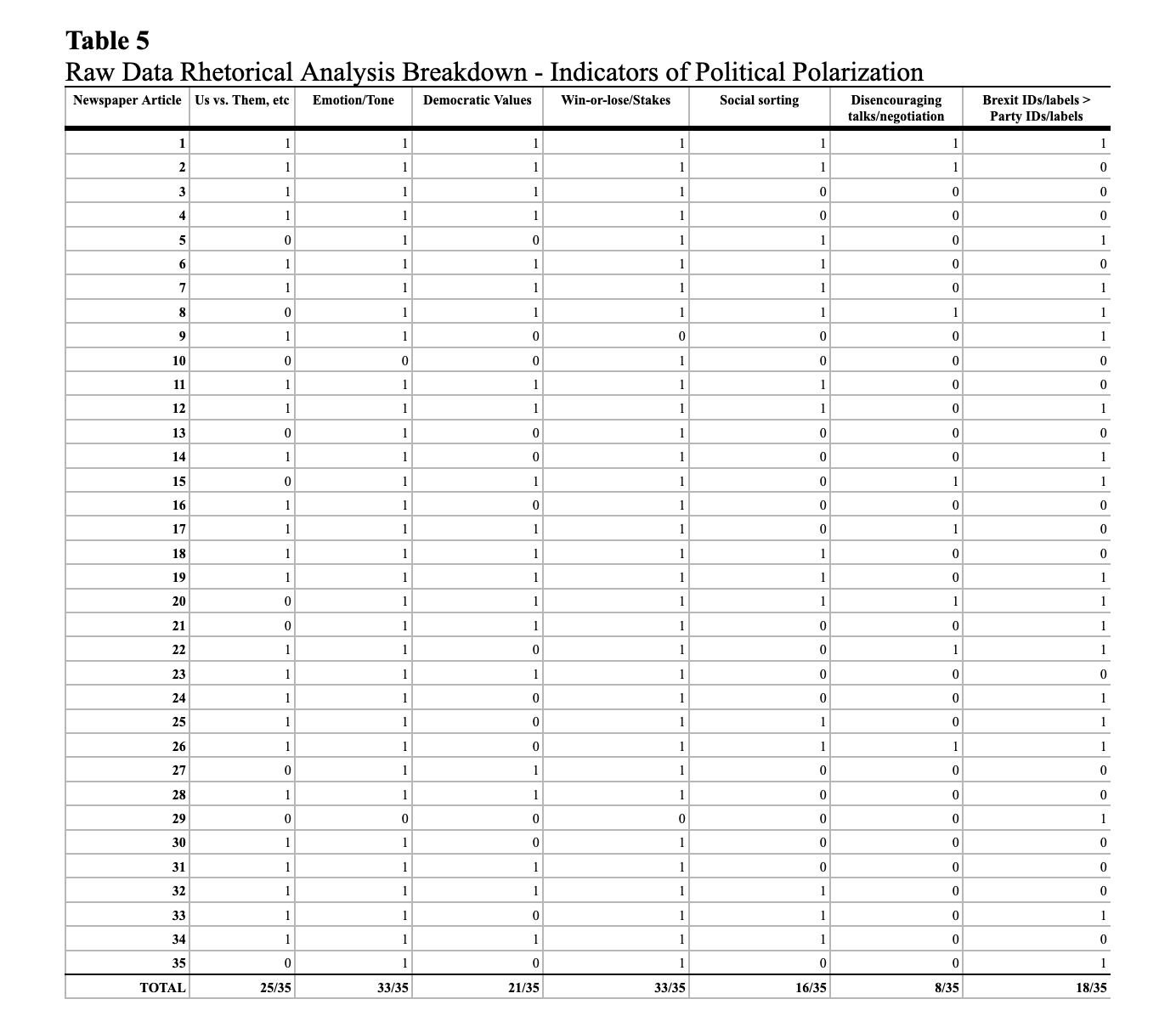
In comparing the raw data collected for political polarization indicators and healthy democratic debate indicators, I found that there were more op-eds that exhibited indicators and characteristics of polarization. Specifically, 25 op-eds exhibited more political polarization, 5 exhibited equal amounts of political polarization and healthy democratic debate, and 5 exhibited more healthy democratic debate. There were consistently more indicators of political polarization than of healthy democratic debate in the op-eds I analyzed. Figure 1 shows the number of op-eds that each indicator occurs in. My first indicator of political polarization, “Us vs. Them”, appeared in 25 out of 35 op-eds. My second indicator, “Emotion/Tone”, appeared in 33 out of 35 op-eds. My third indicator, “Democratic Values”, appeared in 21 out of 35 op-eds. My fourth indicator, “Win-or-Lose/Raised Stakes”, appeared in 33 out of 35 op-eds. My fifth indicator, “Social Sorting”, appeared in 16 out of 35 op-eds. My sixth indicator, “Disencouraging Talks/Negotiation”, appeared in 8 out of 35 op-eds. My seventh indicator, “Brexit IDs Over Party IDs”, appeared in 18 out of 35 op-eds. These results are shown in Figure 1, Indicators of Political Polarization. Furthermore, the raw data of indicators of political polarization in binary coding can be observed in Table 5.
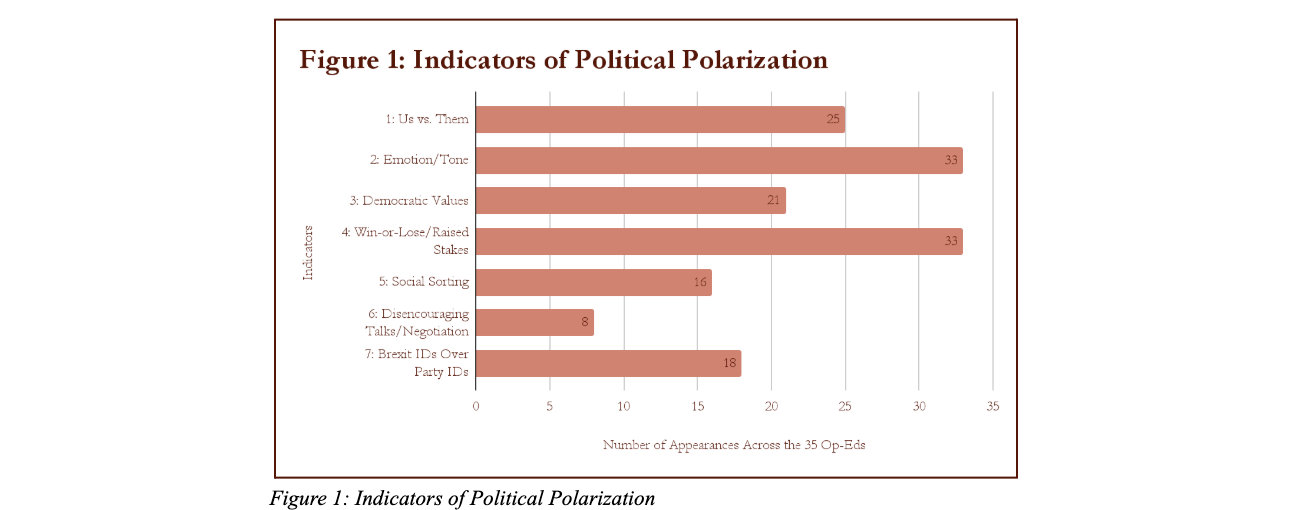
Figure 1: Indicators of Political Polarization
When it comes to indicators of political polarization, my most significant findings were that two indicators, “Emotion/Tone” and “Win-or-Lose/Raised Stakes”, appeared the most frequently and commonly across all 35 randomly selected op-eds, with 33/35 of the op-eds showing negative, polarizing emotion and tone and all that that indicator entails, and 33/35 of the op-eds showcasing raised stakes and win-or-lose framing being applied. These two indicators, being consistently identified across my selection of op-eds, show that the Brexit debate elicited a lot of emotions among voters within the U.K., relying upon charged emotions and reactions, negative attitudes, extreme wording, and one-sided perspectives and observations of the political discussions occurring and the actions taken by political actors to convey a divisive, polarizing view of the Brexit debate. I had expected that these two indicators to be especially prominent and frequent across my 35 op-eds, and my analysis shows that. My least significant finding was that my sixth indicator for political polarization, “Disencouraging Talks/Negotiation”, was the least common or frequent across my 35 op-eds, only being present in 8 op-eds. I expected this indicator to appear more, given that the Brexit debate centered around discussions and the 2016 referendum, as well as many negotiations and agreements with other leaders and officials in the European Union to sort out trade deals and future relations if the U.K. did in fact leave the EU. With talks happening at local, regional, national, and even international levels for such a large-scale issue that would impact various aspects of the U.K. and its society, I figured that several op-eds would focus on negotiations to a heightened degree, also considering the fact that my timeline focused on the years during which the Brexit debate occurred, rather than after the U.K. officially left the EU. However, only 8 op-eds discouraged talks and negotiation surrounding the Brexit debate. The majority of the indicators of political polarization were more frequent across my 35 randomly selected op-eds, five of them appearing in more than 50% of the op-eds, the remaining two appearing in less than 50% of the op-eds (although one of them, “Social Sorting”, appears in 16/35 op-eds, which is very close to half of the total number of op-eds).
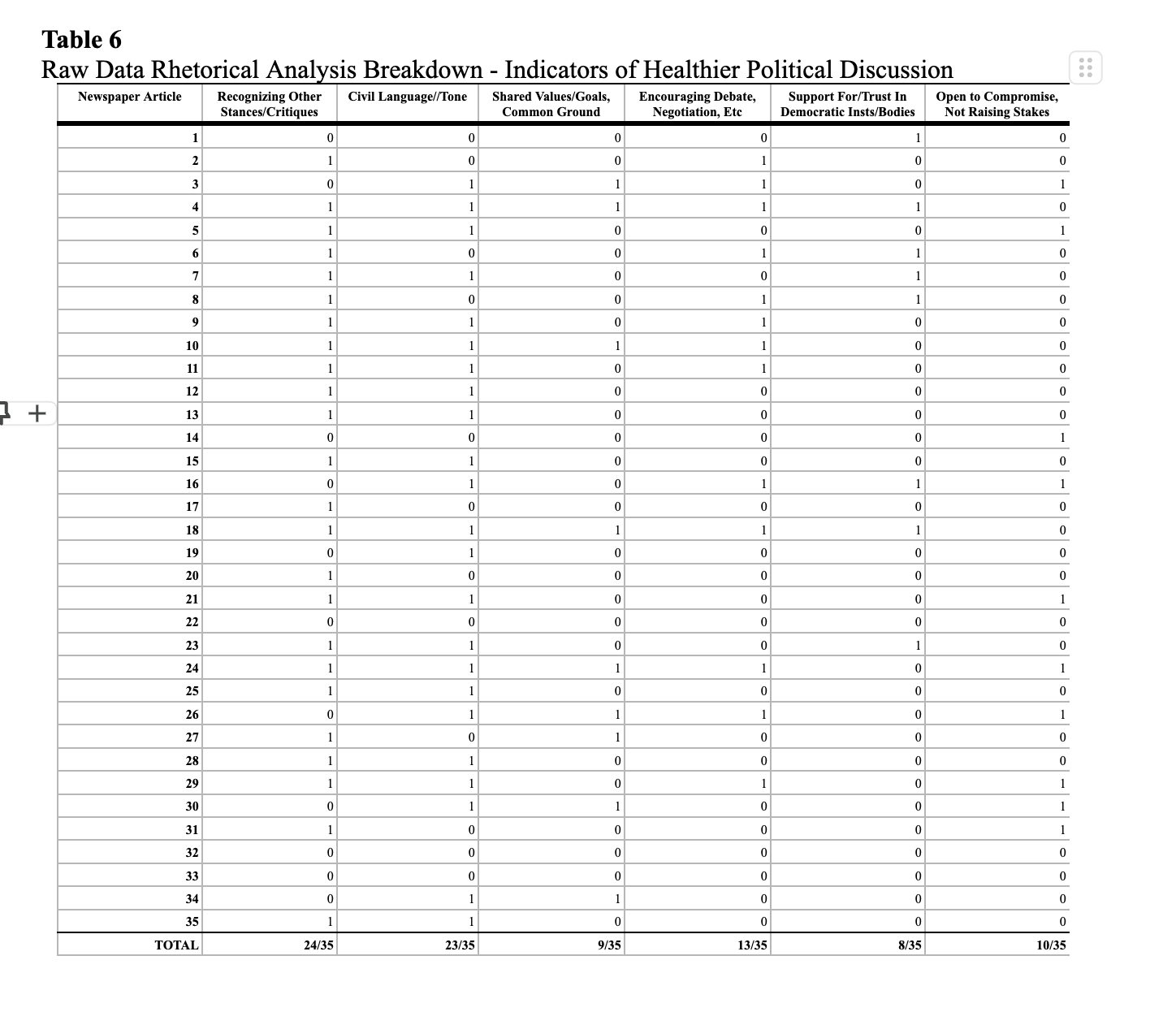
To compare political polarization’s presence to the number of indicators of healthy democratic debate detected throughout my 35 randomly selected op-eds, as shown in Figure 2, my first indicator of healthy democratic debate, "Acknowledging Other Stances/Critiques”, appeared in 24 out of 35 op-eds. My second indicator, “Civil Language/Tone”, appeared in 23 out of 35 op-eds. My third indicator, “Shared Values/Goals, Common Ground”, appeared in 9 out of 35 op-eds. My fourth indicator, “Encouraging Debate, Negotiations, Etc”, appeared in 13 out of 35 op-eds. My fifth indicator, “Support/Trust for Democratic Institutions/Bodies”, appeared in 8 out of 35 op-eds. My sixth indicator, “Open to Compromise, Not Raising Stakes”, appeared in 10 out of 35 op-eds. These results are in Figure 2, Indicators of Healthy Democratic Debate. Furthermore, the raw data of indicators of healthy democratic debate in binary coding can be observed in Table 6.
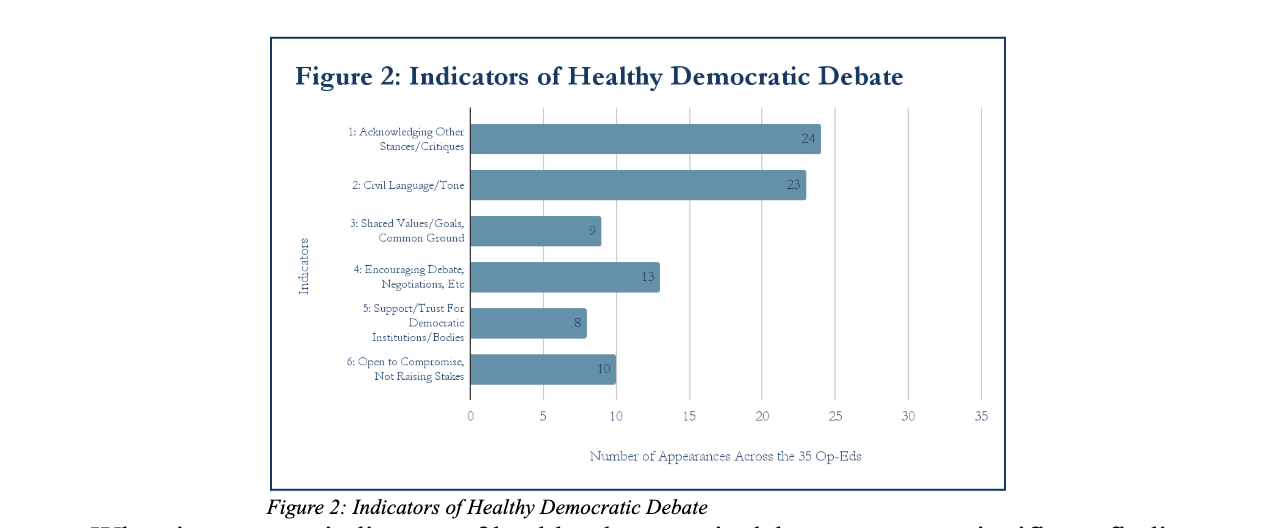
Figure 2: Indicators of Healthy Democratic Debate
When it comes to indicators of healthy democratic debate, my most significant findings were that my first two indicators, “Acknowledging Other Stances/Critiques” and “Civil Language/Tone”, appeared the most frequently and commonly, with 24/35 of the op-eds showing respect to or mentioning the opposition and/or acknowledging critiques towards their favored political actor or party, and 23/35 of the op-eds showing civil, neutral, and uncharged emotion and tone. These indicators, although they did not appear as frequently as the highest indicators of political polarization throughout the 35 op-eds, show that healthier forms of political discussion can still be observed to a certain degree within op-eds focusing on major, consequential, divisive topics, such as the Brexit debate. The rest of the indicators of healthy democratic debate appeared much less frequently. While I did anticipate the varied, limited presence of healthy democratic debate among my 35 op-eds, I didn’t expect some of its indicators, like the first two, to appear as frequently across the op-eds as they did. My least significant finding was that my fifth indicator for healthy democratic debate, “Support/Trust for Democratic Institutions/Bodies”, was the least common or frequent across my 35 op-eds, only being present in 8 op-eds, the same amount as the least common political polarization indicator. Yet, I expected my fifth healthy democratic debate indicator to appear much less often, reflecting my hypothesized claim that the Brexit debate would be more of a case of political polarization. The majority of the indicators of healthy democratic debate were less frequent across my 35 randomly selected op-eds, four of them appearing in less than 50% of the op-eds, the remaining two appearing in more than 50% of the op-eds.
I found evidence from my content/rhetorical analysis of my 35 op-eds that my overall hypothesized claim is supported because characteristics, rhetoric, and journalistic language corresponding to indicators of political polarization appear more frequently than characteristics, rhetoric, and journalistic language corresponding to indicators of healthy democratic/political debate. My 35 op-eds showcased more politically divisive and polarizing aspects of journalism, consequently showing the great influence media outlets and news publications can have on public opinion on difficult, major issues in a nation’s politics, especially when it comes to the pressing discussion throughout the U.K. concerning whether to remain in or leave the EU.
On the other hand, my content analysis of my 35 op-eds also showed that even while journalistic work and pieces can be polarizing and divisive during large-scale, major issues that a particular country may be facing, it can still show and contain signs of healthier democratic debate. Indicators and/or characteristics of healthy democratic debate, while they appeared less often across all 35 randomly selected op-eds, were still present at varying degrees within the op-eds I analyzed; signs of healthy democratic debate often appeared alongside characteristics and evidence of polarization or, in a few instances, were more present in op-eds than polarizing characteristics.
Moreover, my analysis shows how recognizing and separating polarization from healthy debate within rhetoric and newspaper articles is not a straightforward process, even though scholars have already established distinguishing traits between the two forms of political discussion. Despite developing several different indicators, there was overlap in my coding, which shows how healthy debate and polarization can appear side by side. Op-eds 3, 9, 13, 18, and 30 were significant because they contained the same number of indicators of polarization and healthy debate. The indicators “Emotion/Tone” and “Civil Language/Tone” appeared in all five op-eds (100%), “Us vs. Them” and “Win-or-Lose/Raised Stakes” appeared in 4/5 op-eds (80%), “Acknowledging Other Stances/Critiques”, “Shared Values/Goals, Common Ground”, and “Encouraging Debate, Negotiations, Etc” appeared in 3/5 op-eds (60%), “Democratic Values” and “Open to Compromise, Not Raising Stakes” appeared in 2/5 op-eds (40%), “Social Sorting”, “Brexit IDs Over Party IDs”, and “Support/Trust for Democratic Institutions/Bodies” appeared in 1/5 op-eds (20%), and “Disencouraging Talks/Negotation” appeared in 0/5 op-eds. Significant numbers of both types of indicators were present, showing how an op-ed or political rhetoric in general can exhibit exclusive and inclusive stances, charged and civil tone, trust and distrust in democratic institutions/processes, and raised and lowered stakes. This noticeable overlap illustrates the difficulty distinguishing divisive and problematic political discussion from healthier forms within political rhetoric.
The Brexit debate consisted of two major parties: Leave and Remain. Leavers, being Pro-Brexit and wanting to separate from the EU, typically did not disencourage negotiations. The Leave campaign wanted there to be talks between the U.K. and the EU, so that Brexit could officially happen. On the other hand, Remainers, being Anti-Brexit and wanting the U.K. to stay a member of the EU, were usually skeptical and unsure Brexit would work, remarking that the U.K. would lose and be disadvantaged if it officially left the EU. I further analyzed my 35 op-eds based on Leavers’ and Remainers’ expected attitudes, as some of my indicators focus on the nature of negotiations and stakes, and the newspapers I used varied in their Brexit stance. Of my 35 op-eds, 14 were from The Guardian, a generally pro-Remain newspaper, and 18 were from The Sun, The Daily Telegraph, and The Times, three generally pro-Leave newspapers (The Financial Times is a centrist paper and did not take a clear stance). Of the 14 pro-Remain op-eds, 13 exhibited raised stakes, and 2 did not (showing overlap between indicators of polarization and healthy debate). The Remain campaign emphasized that Brexit would be disadvantageous for the U.K., so this substantial majority was expected. Of the 18 pro-Leave op-eds, 17 exhibited raised stakes, and 8 did not (also showing overlap between indicators of polarization and healthy debate). I found that both groups, Leave and Remain, despite their different opinions on Brexit’s potential, frequently created high stakes and used win-or-lose framing. Of the 18 pro-Leave op-eds, only 3 encouraged negotiations, whereas 5 disencouraged them. I didn’t expect this small number of op-eds, as the Leave campaign typically did not disencourage talks and wanted the U.K. to go through the Brexit process. Of the 14 pro-Remain op-eds, 6 encouraged negotiations, whereas 3 disencouraged them. Both groups, Leave and Remain, despite their varying motivation to negotiate Brexit, showed similar numbers. These findings are shown in Table 1.

Table 1 - Polarization and Health Debate Across Publications According to Leave vs. Remain
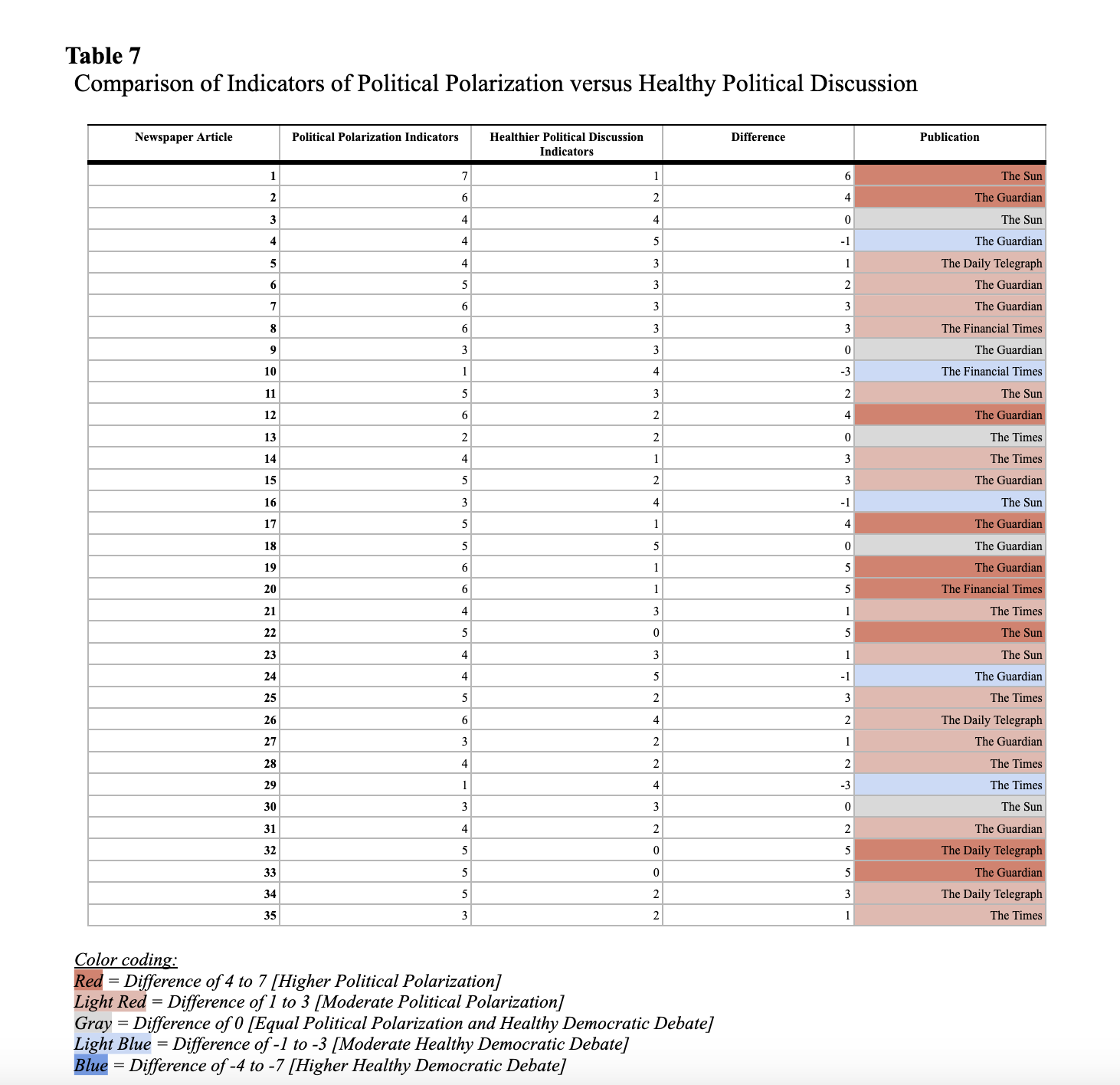
To account for all of this variability, as well as to observe how the indicators of political polarization and indicators of healthy democratic debate compare within each individual op-ed, I took the number of indicators of healthy democratic debate present in an op-ed and subtracted it from the number of indicators of political polarization present in the same op-ed. I found the difference for all 35 of my randomly selected op-eds, with a positive difference meaning more political polarization than healthy democratic debate, a negative difference meaning more healthy democratic debate, and a difference of ‘0’ meaning an op-ed had the same number of indicators of political polarization and healthy democratic debate, therefore canceling out. The resulting differences and a summarized comparison of indicators of political polarization to those of healthy democratic debate are shown in Table 2 (a more detailed, thorough breakdown of the amount of both types of indicators per op-ed can be observed in Table 7 in the Appendix).
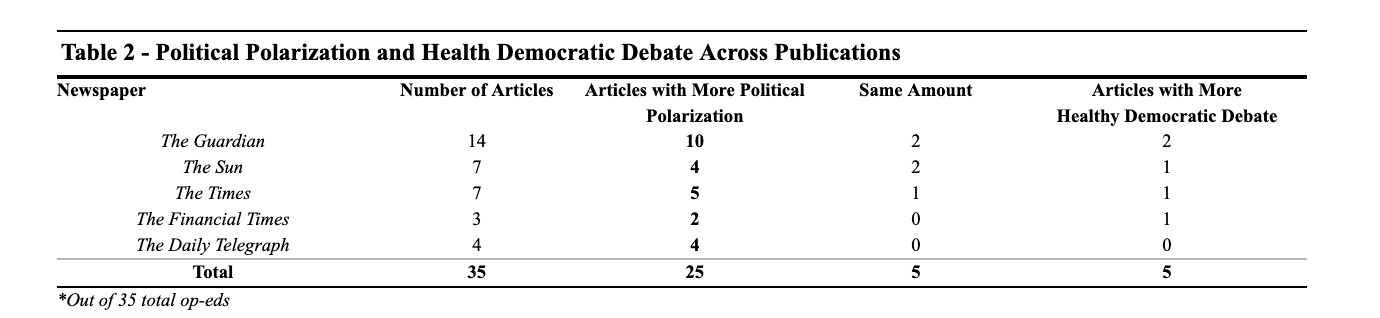
Table 2 - Political Polarization and Health Democratic Debate Across Publications
Regarding the source of publication, The Guardian was the most common newspaper to appear across my 35 randomly selected op-eds, accounting for 40% of them. On the other hand, The Financial Times was the least common newspaper to appear across the 35 op-eds, only making up 8.6% of them. A potential reason for The Guardian’s frequent appearance as the publication for many of the 35 op-eds that would be important to note is that throughout the entirety of the Brexit debate, from 2016 to 2020, the Conservative Party had control in Parliament, and the three consecutive Prime Ministers that were in office from the announcement of the referendum to the U.K.’s exit from the EU were all Conservative: David Cameron, Theresa May, and Boris Johnson. This would most likely generate more response, criticism, and antagonization from the opposition, not only within Parliament and among political actors, but also among media outlets and sources that are historically left-wing, a prominent example being The Guardian; this could explain the greater number of op-eds from The Guardian in comparison to the rest of newspapers. The Sun, The Daily Telegraph, and The Times lean center-right to right-wing, while The Financial Times has a more centrist view, as it is focused on more economic, trade, and business reporting.
To further compare the 35 op-eds, I determined the difference between the two types of indicators within each op-ed, subtracting the number of indicators of healthy democratic debate present from the number of indicators of political polarization present. After determining the differences, I found that of my 35 randomly selected opinion pieces and editorials, 25 of them (or 71.4%) exhibited a positive difference and therefore more political polarization, 5 of them (or 14.3%) exhibited a difference of ‘0’ and therefore equal amounts of political polarization and healthy democratic debate, and 5 of them (or 14.3%) exhibited a negative difference and therefore more healthy democratic debate. This, of course, supports my hypothesized claim, as a large majority of the op-eds show more political polarization. All five publications, The Guardian making up 14/35 of my op-eds, The Sun making up 7/35 of my op-eds, The Times making up 7/35 of my op-eds, The Financial Times making up 3/35 of my op-eds, and The Daily Telegraph making up 4/35 of my op-eds, show more indicators and characteristics of political polarization. Of the 14 op-eds from The Guardian, 10 of them, or 71.4%, showcase more political polarization than healthy democratic debate, 4 of the 7 op-eds from The Sun, or 57.1%, showcase more political polarization than healthy democratic debate, 5 of the 7 op-eds from The Times, or 71.4%, showcase more political polarization than healthy democratic debate, 2 of the 3 op-eds from The Financial Times, or 66.6%, showcase more political polarization than healthy democratic debate, and 4 of the 4 op-eds from The Daily Telegraph, or 100%, show more political polarization than healthy democratic debate. Of course, some of these majorities and percentages are more dispersed than others, but irregardless, each of the five newspapers, ranging in political party affiliation and ideological leaning, even after subtracting the amount of indicators of healthy democratic debate, show the heightened presence of political polarization across the op-eds sourced from them, which supports my hypothesized claim. While there were only four randomly selected op-eds that were from The Daily Telegraph, the newspaper is significant, as I found that 100% of its op-eds had more political polarization. Additionally, it was also significant to observe the number of op-eds from The Guardian that showcased more political polarization, 10, in comparison to only 2 having the same amount of indicators of political polarization and healthy democratic debate that canceled out, and 2 having more healthy democratic debate.
It is also interesting and significant that the year 2016 appeared most often across my 35 randomly selected op-eds, with 11 of the op-eds in my sample being published that year. However, this differs from my search for op-eds and the 3,027 op-eds I collected. Of the total number of op-eds I found in my search published within my selected timeline (February 22, 2016 to January 31, 2020), only 711 op-eds (or 23.5%) were published in 2016. The most frequently recurring year of publication across the full number of 3,027 op-eds was 2019, with 870 op-eds (or 28.7%) being published that year. So, according to my sample, the year 2016 appeared most often, whereas according to the total number of 3,027 op-eds, the year 2019 appeared most often. I had expected many op-eds to have been published in 2016, as that year brought a lot of attention to the Brexit debate; PM at the time David Cameron announced a referendum to take place, which obviously generated a lot of response and discussion, most likely increasing the number of opinion pieces, editorials, and other forms of media being published across the U.K. focusing on major political issues and topics, the newest and largest one being whether or not to remain in the EU. The year 2016 commenced the democratic process of choosing to either part ways with the EU or continue to be part of it, and therefore the country and its newspapers and publications were centered around the Brexit debate. Although 2016 was the most common year of publication in my sample, it didn’t constitute the majority of publications in my sample, as the years of publication were rather dispersed and distributed. No op-ed in my sample was published in 2020, and I had expected very few op-eds, if any, to be published then, considering the U.K. was finalizing its steps to leave the EU, rather than continue to debate, negotiate, and discuss the matter. The second most common year of publication in my sample was 2019, appearing 9 times, which does hold some significance that I had anticipated. In 2019, a general election was held, and a major change in power occurred: PM Theresa May resigned, and her foreign secretary, Boris Johnson, became the new PM and leader of the Conservative Party. This would explain more attention and focus being gravitated towards the Brexit debate, as such a big change in leadership impacted conversations, negotiations, and attitudes, whether it be at the international level with the EU, or within U.K. politics. The distribution of the year of publication across my 35 op-eds is shown in Table 3.

Table 3 - Op-Ed’s Year of Publication
Of course, the obvious limitation that is part of my thesis and data collection is the fact that I do have the sufficient time to analyze and determine the presence of characteristics and indicators of political polarization and healthy democratic debate in every single op-ed that was in my spreadsheet. It would certainly be more telling and accurate if I were to dedicate an extensive amount of time and work to analyzing the hundreds of opinion pieces and editorials with the filters and specific details I relied upon. Additionally, while there are other forms of research to determine the extent to which the Brexit debate is a case of political polarization, such as viewing polling data and voting, but my research question distinctly asks about discussion, debate, and conversation, which cannot be detected merely by observing such data about Brexit, which is why analyzing op-eds is credible and legitimate. It is also important to acknowledge that I did find op-eds (across the five different newspapers) that showed characteristics pertaining to healthy democratic debate, sometimes more than political polarization, showing that, while my hypothesized claim was found to be supported, it is vital to address and take note of the presence of healthier political discussion that can exist during pressing, difficult, divisive topics such as the Brexit debate.
Conclusion
To conclude, based on the rhetorical content analyzed across my 35 randomly selected op-eds, there is supporting evidence for my hypothesized claim that the newspaper debate about Brexit is in fact a case of political polarization rather than healthy democratic debate, and that there was more polarization and divisive language, rhetoric, and traits present in U.K. media covering a difficult, major topic like Brexit. Overall, the op-eds that I randomly sampled and analyzed showed more traits of political polarization than of healthy democratic debate; however, many of them contained indicators of both. My findings showed that the Brexit debate was a more significant example of the unhealthy, negative dynamics of journalism and rhetoric in the modern world. In addition, my findings also reveal that even while carrying out democratic processes and relying upon established institutions to face national issues, developed democracies have been, are, and will still be vulnerable to and impacted by political polarization and unhealthy discourse, whether it be originating from political actors, parties, or the press and newspaper op-eds.
Although I believe my findings are valuable to the greater scope of the nature of political polarization and healthier political discussion in developed democracies, further research can be conducted and more questions can be addressed that relate to my overarching question, claim, and content I analyzed. For instance, I believe it would be beneficial to test how op-eds differ in terms of political polarization and healthy democratic debate among the different constituencies that make up the United Kingdom: England, Wales, Scotland, and Northern Ireland. The five newspapers I chose, while they are five of the most popular, most circulated, and recognized publications throughout the U.K., all happen to be based in England, specifically London. If I had more time, it would be interesting to repeat the process of selecting my op-eds for each U.K. constituency: choosing five of the most popular English newspapers, then five Welsh newspapers, then five Scottish newspapers, and then five Northern Irish newspapers, performing random selections for each group, and analyzing the op-eds for each constituency. That way, I would be able to analyze and evaluate many newspapers varying in location as well as political alignment across the U.K., which would widen the scope and provide a more representative collection of op-eds covering the Brexit debate.
In conducting my research, I hoped to show how political polarization and healthy democratic debate in a country’s media, specifically its op-eds, could be applied to developed democracies and their political atmospheres. It would be interesting to observe other unique, major political events identified in other advanced democracies, such as the United States, France, Germany, Scandinavia, and others. If I applied my research process to these countries and their unique events (or perhaps their newspaper coverage of the Brexit debate, so as to gather international perspective on Brexit), would I find results similar to those from my analysis of U.K. op-eds? While it would be worthwhile to carry this out, it would require several extensive content analyses and a lot more time that I as an undergraduate student don’t have.
While my research focuses on the Brexit debate, it applies to politics and all us citizens that consistently engage in political discussion and with institutions every day. Political debate can often be a site of division and tension, which can discourage further discussion and make people less inclined to talk with those with opposing political opinions. Polarization, while it can solidify ideological lines, construes what it means to have a productive, healthy, democratic conversation without becoming too destructive and hostile. My research exhibits prominent signs and indicators of both political polarization and healthy democratic debate, which can be applied to political discussions in developed democracies, like here in the United States. For us citizens, it is necessary to be aware and self-conscious of the language, attitude, and rhetoric we use during political discussion. There is a difference between disagreeing with someone over politics and inciting overly divisive, polarizing political conversations that hinder progress and communication between opposing ideologies. Citizens must know how to distinguish problematic politics from healthier forms of political discussion, and I believe I have provided to fellow democratic citizens around the country and the world a better understanding of what makes political polarization political polarization and what makes healthy debate healthy debate.
References
Alt, James E., and David Dreyer Lassen. 2006. “Transparency, Political Polarization, and Political Budget Cycles in OECD Countries.” American Journal of Political Science 50, no. 3: 530–50.
Bennett, Samuel. 2019. “‘Crisis’ as a Discursive Strategy in Brexit Referendum Campaigns.” Critical Discourse Studies 16, no. 4: 449-464.
Benson, Jonathan. 2024. “Democracy and the Epistemic Problems of Political Polarization.” American Political Science Review 118, no. 4: 1719–32.
Boxell, Levi, Matthew Gentzkow, and Jesse M. Shapiro. 2024. “Cross-country Trends in Affective Polarization.” Review of Economics and Statistics 106, no. 2: 557-565.
Chakrabortty, Aditya. 2019. “Britain is mired in democratic crisis - but it goes much deeper than Brexit; It features throughout our everyday lives: in our privately run academy schools and the outsourcing of our public services.” The Guardian(London), September 4. Accessed October 9, 2025. https://advance.lexis.com/api/document?collection=news&id=urn%3acontentItem%3a5WYW-HD51-F021-61Y0-00000-00&context=1519360&identityprofileid=T2WWQG54536.
Curini, Luigi, and Airo Hino. 2012. “Missing Links in Party-System Polarization: How Institutions and Voters Matter.” The Journal of Politics 74, no. 2: 460–73.
Druckman, James N., and Matthew S. Levendusky. 2019. “What Do We Measure When We Measure Affective Polarization?” Public Opinion Quarterly 81, no. 1: 114-122.
Editorial. 2018. “The Guardian view on who governs Britain: amid Brexit chaos, we ought to know; Politics in Britain is in crisis just as the great issue at the heart of British life, withdrawal from the European Union, is in flux. We risk damaging our economy and our politics - irreparably.” The Guardian (London), July 18. Accessed October 9, 2025. https://advance.lexis.com/api/document?collection=news&id=urn%3acontentItem%3a5STX-8C51-F021-60PM-00000-00&context=1519360&identityprofileid=T2WWQG54536.
Felton, James. 2019. “In turning their backs, Brexit MEPs behaved like attention-seeking toddlers; If they think the European parliament is a portrait of excess they should take a closer look at what goes on at Westminster.” The Guardian (London), July 3. Accessed October 9, 2025. https://advance.lexis.com/api/document?collection=news&id=urn%3acontentItem%3a5WGG-P2M1-F021-61TM-00000-00&context=1519360&identityprofileid=T2WWQG54536.
Fiorina, Morris P., Samuel A. Abrams, and Jeremy C. Pope. 2008. “Polarization in the American Public: Misconceptions and Misreadings.” The Journal of Politics 70, no. 2: 556-560.
Fletcher, Richard, Alessio Cornia, and Rasmus Kleis Nielsen. 2020. “How Polarized Are Online and Offline News Audiences? A Comparative Analysis of Twelve Countries.” The International Journal of Press/Politics 25, no. 2: 169-195.
Freedland, Jonathan. 2018. “Brexit reveals our political system is failing. The 48% must have a voice; The government is on a course that defies all logic, but the opposition refuses to oppose. No wonder people feel betrayed.” The Guardian (London), February 9. Accessed October 9, 2025. https://advance.lexis.com/api/document?collection=news&id=urn%3acontentItem%3a5RM0-76M1-F021-62M3-00000-00&context=1519360&identityprofileid=T2WWQG54536.
George, Cherian. 2025. “How to Fight Polarization.” Journal of Democracy. https://www.journalofdemocracy.org/online-exclusive/how-to-fight-polarization/.
Goddard, Alex, and Alex Gillespie. 2023. “Textual Indicators of Deliberative Dialogue: A Systematic Review of Methods for Studying the Quality of Online Dialogues.” Social Science Computer Review 41 no. 6: 2364–85.
Hain, Peter. 2017. “How to avoid a bad Brexit? Rediscover the art of British diplomacy; At this historic moment, Theresa May's team seems not to grasp the most basic rules of negotiation.” The Guardian (London), September 29. Accessed October 9, 2025. https://advance.lexis.com/api/document?collection=news&id=urn%3acontentItem%3a5PKJ-7F11-F021-62NN-00000-00&context=1519360&identityprofileid=T2WWQG54536.
Hannan, Daniel. 2018. “Attack OF THE giant Brexit scaremongers; PROJECT FEAR'S SILLY THREATS.” The Sun (England), June 5. Accessed October 9, 2025. https://advance.lexis.com/api/document?collection=news&id=urn%3acontentItem%3a5SGM-NHX1-JBVM-Y0J7-00000-00&context=1519360&identityprofileid=T2WWQG54536.
Harteveld, Eelco. 2021. “Ticking All the Boxes? A Comparative Study of Social Sorting and Affective Polarization.” Electoral Studies 72 (August): 1-11.
Hobolt, Sara B., Thomas J. Leeper, and James Tilley. 2021. “Divided by the Vote: Affective Polarization in the Wake of the Brexit Referendum.” British Journal of Political Science 51, no. 4: 1476-1493.
Humprecht, Edda. 2018. “Where ‘Fake News’ Flourishes: A Comparison across Four Western Democracies.” Information, Communication & Society 22, no. 13: 1973–88.
Iversen, Torben, and David Soskice. 2015. “Information, Inequality, and Mass Polarization: Ideology in Advanced Democracies.” Comparative Political Studies 48, no. 13: 1781-1813.
Iyengar, Shanto, Yphtach Lelkes, Matthew Levendusky, Neil Malhotra, and Sean J. Westwood. 2019. “The Origins and Consequences of Affective Polarization in the United States.” Annual Review of Political Science 22, no. 1: 129-46.
Kavanagh, Trevor. 2018. “Timid Theresa must fight them on Brexit.” The Sun (England), January 22. Accessed October 9, 2025. https://advance.lexis.com/api/document?collection=news&id=urn%3acontentItem%3a5RG2-RTC1-JBVM-Y45S-00000-00&context=1519360&identityprofileid=T2WWQG54536.
Kibasi, Tom. 2019. “Tom Watson is wrong. We need an election first - and then a second referendum; Only after voters decide which party should govern them should they be presented with a carefully worded Brexit poll.” The Guardian (London), September 11. Accessed October 9, 2025. https://advance.lexis.com/api/document?collection=news&id=urn%3acontentItem%3a5X1D-MRK1-F021-6136-00000-00&context=1519360&identityprofileid=T2WWQG54536.
Levitsky, Steven, and Daniel Ziblatt. 2018. How Democracies Die: What History Reveals About Our Future. New York: Crown Publishers.
Lupu, Noam. 2015. “Party Polarization and Mass Partisanship: A Comparative Perspective.” Political Behavior 37, no. 2: 331-56.
McCoy, Jennifer, and Murat Somer. 2021. “Overcoming Polarization.” Journal of Democracy 32, no. 1: 6-21.
McCoy, Jennifer, Tahmina Rahman, and Murat Somer. 2018. “Polarization and the Global Crisis of Democracy: Common Patterns, Dynamics, and Pernicious Consequences for Democratic Polities.” American Behavioral Scientist 62, no. 1: 16-42.
Reiljan, Andres, Diego Garzia, Frederico Ferreira da Silva, and Alexander H. Trechsel. 2024. “Patterns of Affective Polarization toward Parties and Leaders across the Democratic World.” American Political Science Review 118, no. 2: 654-670.
Roberts, Kenneth M. 2022. “Populism and Polarization in Comparative Perspective: Constitutive, Spatial and Institutional Dimensions.” Government and Opposition 57, no. 4: 680-702.
Roberts-Miller, Patricia. 2005. “Democracy, Demagoguery, and Critical Rhetoric.” Rhetoric and Public Affairs 8, no. 3: 459–76.
Roe-Crines, Andrew S. 2025. “Political rhetoric and democratic discourse.” Global Discourse 15, no. 2-3: 109-122.
Rostbøll, Christian F. 2024. “Polarization and the Democratic System: Kinds, Reasons, and Sites.” Perspectives on Politics 23, no. 1: 1-17.
Schedler, Andreas. 2023. “Rethinking Political Polarization.” Political Science Quarterly 138, no. 3: 335-359.
Shore, Howard. 2016. “The EU is holding our economy back - and Brexit could set it free.” The Daily Telegraph (London), May 13. Accessed October 9, 2025. https://advance.lexis.com/api/document?collection=news&id=urn%3acontentItem%3a5JS2-MH41-DY9P-N4VK-00000-00&context=1519360&identityprofileid=T2WWQG54536.
Stuart, Gisela. 2019. “It's not extreme to want to leave the EU on 31 October, come what may; Politicians have grossly mishandled the Brexit process. Leaving, without a deal if necessary, is the only way to move forward.” The Guardian (London), August 11. Accessed October 9, 2025. https://advance.lexis.com/api/document?collection=news&id=urn%3acontentItem%3a5WST-W2G1-F021-63W1-00000-00&context=1519360&identityprofileid=T2WWQG54536.
Toynbee, Polly. 2016. “Brexit and Trump mark a whitelash. Politicians must not pander to it; The US election result will infect Britain's political psyche, especially on those totemic 'them and us' issues - race, migration, poverty and benefits.” The Guardian (London), November 10. Accessed October 9, 2025. https://advance.lexis.com/api/document?collection=news&id=urn%3acontentItem%3a5M4P-TWD1-JCJY-G2W0-00000-00&context=1519360&identityprofileid=T2WWQG54536.
Van Aelst, Peter, Jesper Strömbäck, Toril Aalberg, Frank Esser, Claes de Vreese, Jörg Matthes, David Hopmann, Susana Salgado, Nicolas Hubé, Agnieszka Stępińska, Stylianos Papathanassopoulos, Rosa Berganza, Guido Legnante, Carsten Reinemann, Tamir Sheafer, and James Stanyer. 2017. “Political Communication in a High-Choice Media Environment: A Challenge for Democracy?” Annals of the International Communication Association 41, no. 1: 3–27.
Warner, Gerald. 2016. “Forget Brexit 'talks'...we've paid bill, now let's check out of the EU hotel; BRITAIN CAN'T WAIT TIL 2017 TO GO.” The Sun (England), August 25. Accessed October 9, 2025. https://advance.lexis.com/api/document?collection=news&id=urn%3acontentItem%3a5KJ7-KB41-DY9P-N058-00000-00&context=1519360&identityprofileid=T2WWQG54536.
Warner, Jeremy. 2016. “London would pay a heavy price for Brexit; The backbone of the City is international banking, and for this, access to the single market is critical.” The Daily Telegraph (London),May 6. Accessed October 9, 2025. https://advance.lexis.com/api/document?collection=news&id=urn%3acontentItem%3a5JPJ-V6R1-DY9P-N22Y-00000-00&context=1519360&identityprofileid=T2WWQG54536.
Yang, JungHwan, Hernando Rojas, Magdalena Wojcieszak, Toril Aalberg, Sharon Coen, James Curran, Kaori Hayashi, Shanto Iyengar, Paul K. Jones, Gianpietro Mazzoleni, Stylianos Papathanassopoulos, June Woong Rhee, David Rowe, Stuart Soroka, and Rodney Tiffen. 2016. “Why Are “Others” So Polarized? Perceived Political Polarization and Media Use in 10 Countries.” Journal of Computer-Mediated Communication 21, no. 5: 349-367.
Younge, Gary. 2019. “Farage and Extinction Rebellion: two politics of protest, only one has a future; The Brexit party and climate protesters share a frustration with conventional politics. There the similarity ends.” The Guardian (London), April 26. Accessed October 9, 2025. https://advance.lexis.com/api/document?collection=news&id=urn%3acontentItem%3a5VYY-B4X1-F021-611B-00000-00&context=1519360&identityprofileid=T2WWQG54536.